1918–1990 · Modern
Leonard Bernstein
2 works
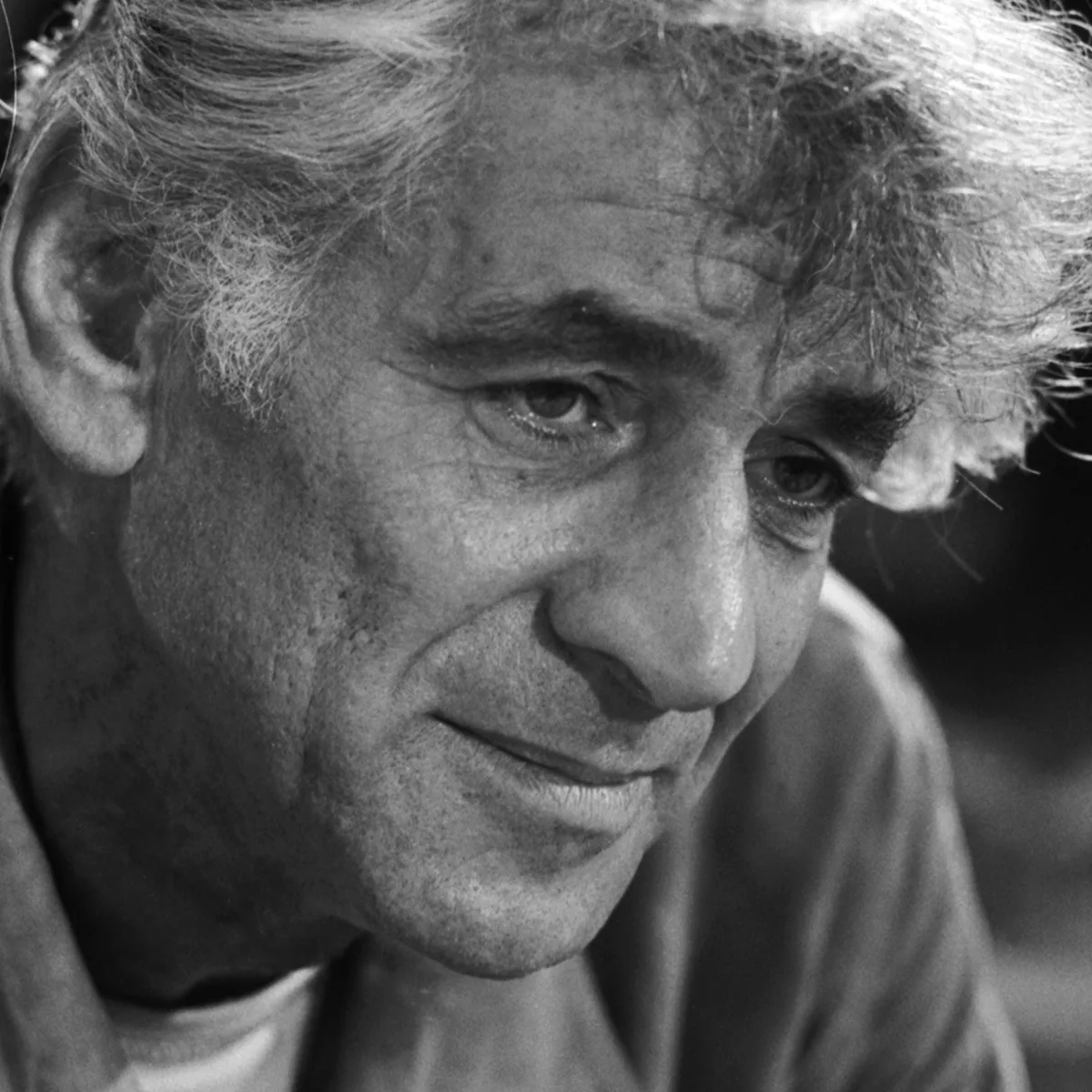
Bernstein was a conductor and pianist as well as a composer, and he wrote for the concert hall and for Broadway. His stage music, above all West Side Story, mixes jazz, Latin rhythms, symphonic sweep and musical-comedy conventions. The two works in the catalog sit at either end of that range: a short theatre overture and a sacred choral piece.
The Candide Overture opens the 1956 operetta Candide. Bernstein orchestrated the overture himself, while Hershy Kay orchestrated the rest of the show. The New York Philharmonic gave its first concert performance under Bernstein on 26 January 1957. It lasts about four and a half minutes and strings together tunes from the show: "The Best of All Possible Worlds", the Battle Music, "Oh, Happy We" and "Glitter and Be Gay", plus melodies written for the overture alone.
Chichester Psalms was commissioned by Walter Hussey, Dean of Chichester Cathedral, for the 1965 Southern Cathedrals Festival. Bernstein conducted the first performance in New York on 15 July 1965, and the Chichester performance followed on 31 July. The texts are Hebrew psalms (100, 108, 2, 23, 131 and 133) for choir and a boy treble or countertenor, with brass, five percussionists, two harps and strings. The first movement is in 7/4, grouped 2+2+3. In the second, a calm setting of Psalm 23 is interrupted by Psalm 2, and the men's theme there was adapted from a number cut from West Side Story. The finale ends on a unison G with a slight major third.
What to listen for
- The Candide Overture is built from show tunes. Try to name them as they pass, and notice how each is re-coloured by the orchestra.
- In Chichester Psalms, the 7/4 metre of the first movement, counted 2+2+3, which gives the dance a lopsided lilt.
- The interruption in the second movement: gentle Psalm 23 against the harsher Psalm 2.
- The harp parts, which Bernstein wrote before the orchestral and choral parts, and the five percussionists.
- The ending of Chichester Psalms: a unison G with a faint major third at the very end.
Sources: Leonard Bernstein (Wikipedia), Chichester Psalms (Wikipedia), Candide (operetta) (Wikipedia)