1898–1937 · Modern
George Gershwin
4 works
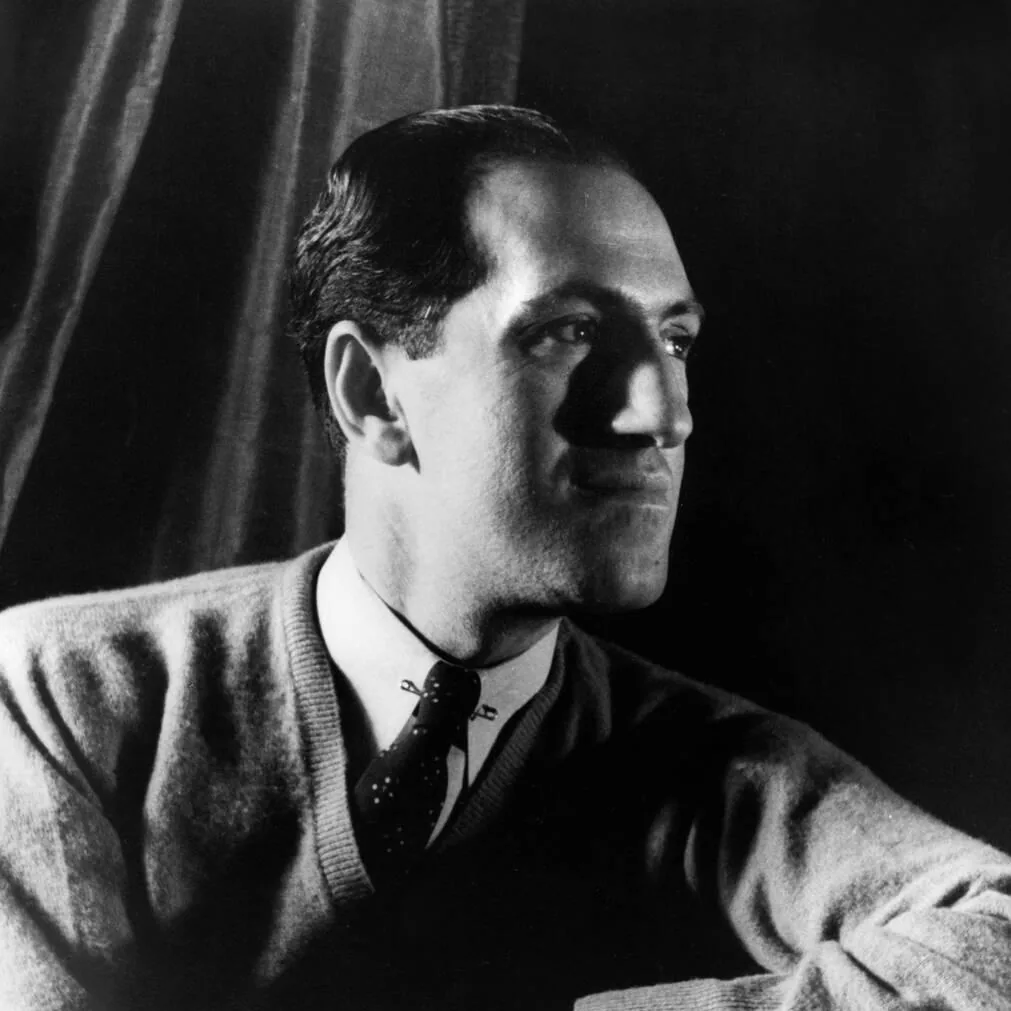
Gershwin was born in New York to Jewish immigrant parents from the Russian Empire. At fifteen he left school to work as a song plugger on Tin Pan Alley, and he wrote Broadway shows with his brother Ira before he wrote for the concert hall. His first national hit, "Swanee", came in 1919. That background is audible in the concert works: blues and ragtime syncopations, Hispanic rhythms, flattened sevenths and blue notes, set inside classical shapes. The critic Greenberg also hears the cadences of Hebrew chant, and traces of Chopin, Liszt and Debussy in the harmony.
The three catalog titles come from 1924 to 1926, when he moved from the stage to the concert hall. Rhapsody in Blue was written in about five weeks for Paul Whiteman's concert "An Experiment in Modern Music" (Aeolian Hall, 12 February 1924), with Gershwin at the piano. Ferde Grofé orchestrated it for Whiteman's jazz band of about 23 players. It is one continuous movement that begins and ends in B-flat major. The Concerto in F was commissioned by Walter Damrosch for the New York Symphony, and this time Gershwin scored every note himself. He played the premiere at Carnegie Hall on 3 December 1925.
The Three Preludes (1926) are for solo piano and were dedicated to his adviser Bill Daly. Gershwin first planned a set of 24, then cut it to the three that were published.
What to listen for
- The clarinet glissando, a long slide between notes, that opens Rhapsody in Blue, and the blue notes (lowered sevenths) in the themes that follow.
- The Charleston rhythm and pentatonic runs in the first movement of the Concerto in F.
- The solo trumpet that opens the slow movement of the Concerto, in a blues-coloured D-flat major.
- The first prelude: fast, decisive, built on a five-note blues motif with syncopated rhythm.
- The second prelude, which Gershwin called a "blues lullaby": a melody over a steady bass line, much slower.
Sources: George Gershwin (Wikipedia), Rhapsody in Blue (Wikipedia), Concerto in F (Gershwin) (Wikipedia), Three Preludes (Gershwin) (Wikipedia)