1843–1907 · Romantic
Edvard Hagerup Grieg
8 works
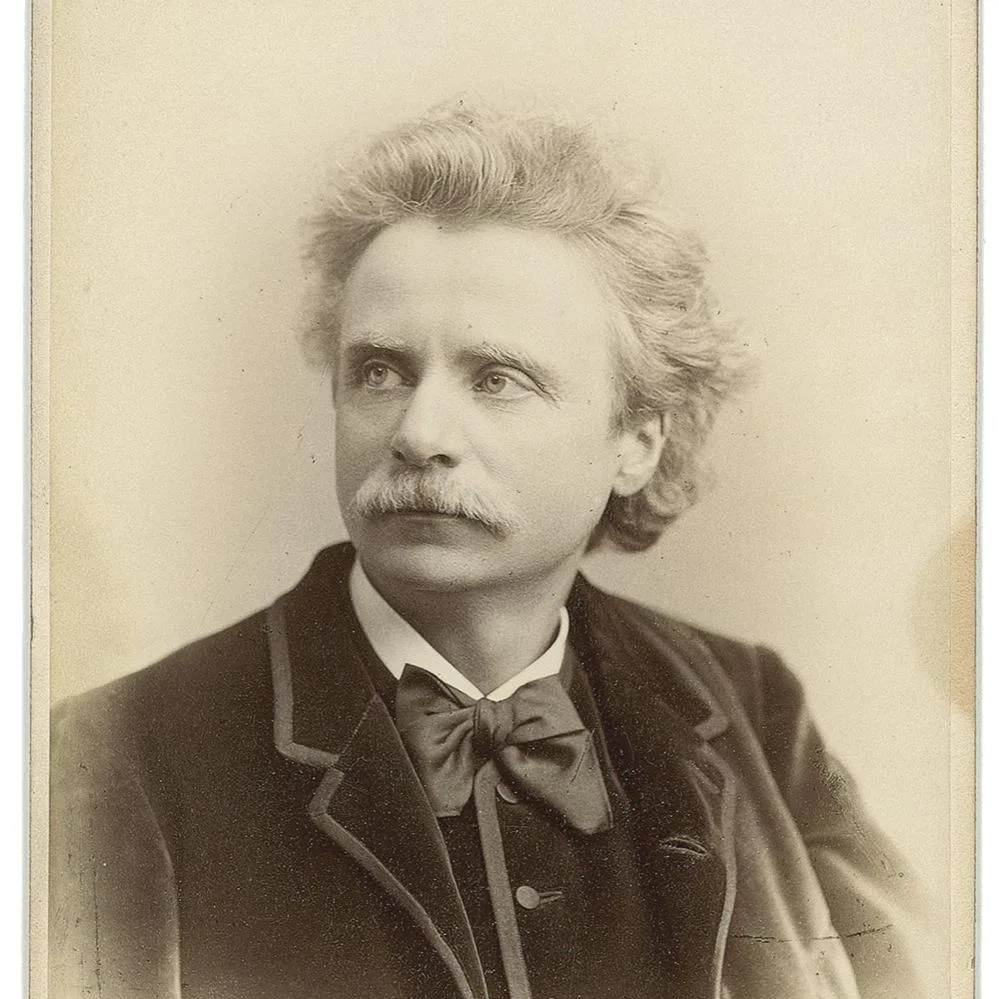
Grieg was born in Bergen in 1843 and died there in 1907. He studied at the Leipzig Conservatory, spent about three years in Copenhagen from 1863, and later conducted in Christiania (now Oslo). His home was Troldhaugen, near Bergen. He used Norwegian folk music to help build a national musical identity. You hear it in short melodic turns, such as the falling minor second and major third that open the Piano Concerto, and in dance rhythms such as the halling in the concerto's finale. His best-known body of work is the sixty-six Lyric Pieces for piano, written between 1867 and 1901.
The catalog covers most of his forms. The Piano Sonata, Op. 7 (1865, revised 1887) is his only piano sonata. The Piano Concerto, his only completed concerto, was written in Denmark in 1868 and first played in Copenhagen on 3 April 1869 by Edmund Neupert. The Ballade, Op. 24, is a theme and fourteen variations on a Norwegian folk song, The Northland Peasantry. Two of his three violin sonatas appear: No. 2 (1867), which he called the Norwegian one, and No. 3 (1887), which he described as the one with the broader horizon.
Orchestral and descriptive music is here too. The Holberg Suite (1884) marked the 200th birthday of the playwright Ludvig Holberg and recasts old forms, prelude, sarabande, gavotte, air and rigaudon, in nineteenth-century harmony. Grieg wrote it for piano and arranged it for strings a year later. Peer Gynt Suite No. 1 (published 1888) takes four numbers from his 1875 music for Ibsen's play. Wedding Day at Troldhaugen (1896) was written to mark his silver wedding anniversary.
What to listen for
- The Piano Concerto opens with a timpani roll and a dramatic piano flourish that falls a minor second and then a major third; the finale has the lilt of a halling dance.
- In Violin Sonata No. 2, the slow, dark G minor introduction before the first theme arrives in G major. In No. 3, the bold C minor first theme against a lyrical second theme in E-flat major.
- In the Ballade, the sad folk theme at the start, the hushed fifth variation, the major-key twelfth variation, and the prestissimo fourteenth.
- In the Holberg Suite, five short movements in the shapes of eighteenth-century dances, with Grieg's romantic harmony under the old forms.
- In Peer Gynt Suite No. 1, four contrasting numbers: Morning Mood (E major), The Death of Åse (B minor), Anitra's Dance (A minor) and In the Hall of the Mountain King (B minor).
- In Wedding Day at Troldhaugen, a festive, march-like first section followed by a quieter, reflective one.
Sources: Edvard Grieg (Wikipedia), Piano Concerto (Grieg) (Wikipedia), Violin Sonata No. 2 (Grieg) (Wikipedia), Violin Sonata No. 3 (Grieg) (Wikipedia), Piano Sonata (Grieg) (Wikipedia), Ballade in the Form of Variations on a Norwegian Folk Song (Wikipedia), Holberg Suite (Wikipedia), Peer Gynt (Grieg) (Wikipedia), Wedding Day at Troldhaugen (Wikipedia)
Works
 GriegPiano Sonata in E minor, Op. 7GriegViolin Sonata No. 2 in G major, Op. 13GriegPiano Concerto in A minor, Op. 16GriegBallade in G minor, Op. 24GriegHolberg Suite (From Holberg’s Time), Op. 40GriegViolin Sonata No. 3 in C minor, Op. 45GriegPeer Gynt Suite No. 1, Op. 46GriegLyric Pieces: Wedding Day at Troldhaugen, Op. 65 No. 6