1895–1963 · Modern
Paul Hindemith
2 works
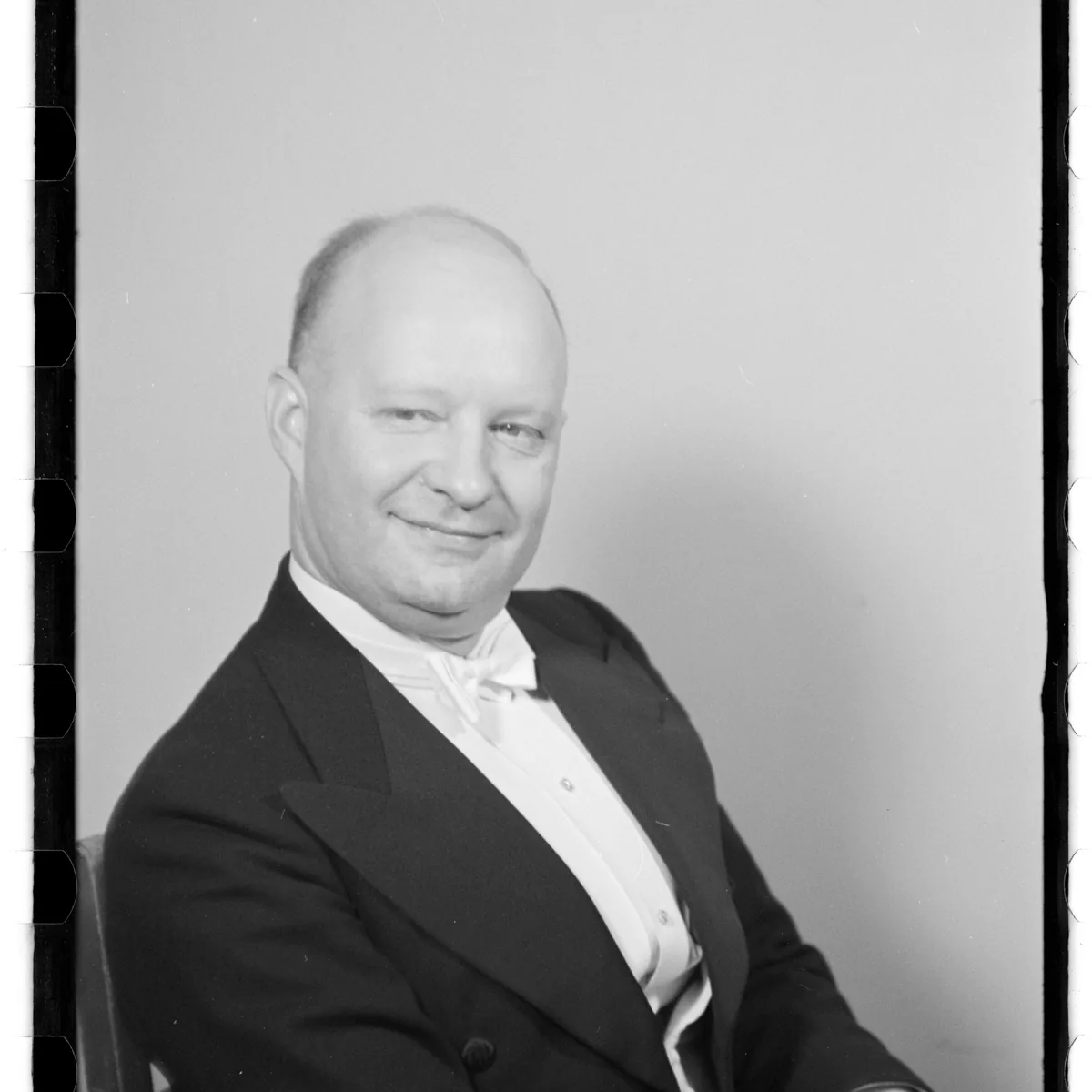
Hindemith was born in Hanau, near Frankfurt, in 1895 and died in Frankfurt in 1963. He was a violist, conductor, teacher and theorist as well as a composer, and he founded the Amar Quartet in 1921. In the 1920s he was a leading figure of the Neue Sachlichkeit (New Objectivity) movement, and his Kammermusik series dates from 1922 to 1927. His music is contrapuntal, with independent lines, and tonal but not diatonic: it draws on all twelve notes while keeping a sense of key. He set out the system in his three-volume treatise The Craft of Musical Composition. He went to Turkey in 1935 to help build a music school, and the Nazis banned his music in 1936; he moved to Switzerland in 1938 and to the United States in 1940, where he taught mainly at Yale.
The Mathis der Maler Symphony dates from 1934 and was first played on 12 March 1934 by the Berlin Philharmonic under Wilhelm Furtwängler. It grew out of his plans for an opera about the painter Matthias Grünewald, and each of its three movements relates to a panel of Grünewald's Isenheim Altarpiece. Furtwängler faced severe criticism from the Nazi party for performing it.
The Symphonic Metamorphosis of Themes by Carl Maria von Weber was written in the United States in 1943 (the full score is dated 29 August) and first played by the New York Philharmonic under Artur Rodziński on 20 January 1944. It began as a ballet on Weber's music proposed by the choreographer Léonide Massine in 1940. When that fell through, Hindemith made a concert piece in four movements from Weber's little-known piano duets and his incidental music to Gozzi's play Turandot, for a large orchestra with extensive percussion.
What to listen for
- In the Mathis symphony, the first movement's introduction quotes the folk song "Es sungen drei Engel" before three main themes follow.
- The second movement, Entombment, opens on a bare fifth and gradually adds more dissonant notes, so the music has a centre without ordinary functional harmony.
- The third movement, the Temptation of Saint Anthony, is the most turbulent, with a nightmarish, Bosch-like character.
- In the Weber work, the four movements (Allegro, Turandot Scherzo, Andantino, March): Weber's tunes can be followed, but the harmony and the orchestral colour, with a busy percussion section, are Hindemith's.
- Lines that move independently against each other, the contrapuntal writing on which his style rests.
Sources: Paul Hindemith (Wikipedia), Mathis der Maler (symphony) (Wikipedia), Symphonic Metamorphosis of Themes by Carl Maria von Weber (Wikipedia)