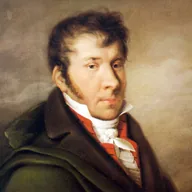
1778–1837 · Classical
Johann Nepomuk Hummel
1 work
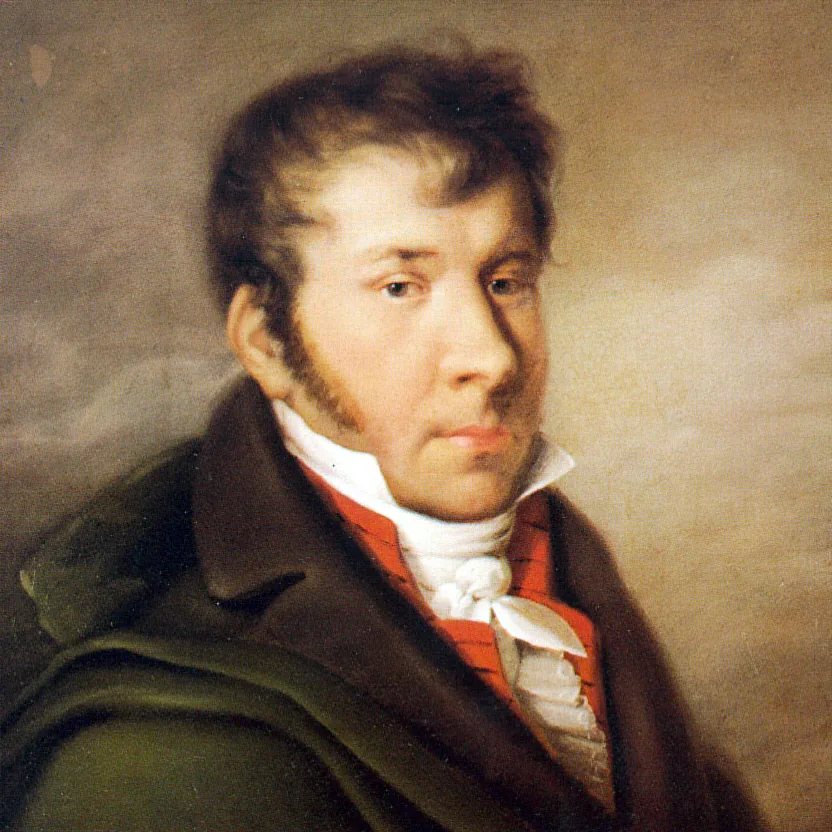
Hummel was born in Pressburg (now Bratislava) in 1778 and died in Weimar in 1837. A child prodigy, he studied with Mozart, Haydn, Salieri and Albrechtsberger. He succeeded Haydn as Konzertmeister at the Esterházy court in 1804, then held Kapellmeister posts in Stuttgart (1816 to 1818) and Weimar (1819 to 1837), where he knew Goethe. He was one of the great piano virtuosi of his day, wrote eight piano concertos and ten piano sonatas, and published a widely used piano instruction book in 1828. He wrote no symphonies. His music stands between the Classical and Romantic styles, and it left a mark on the early works of Chopin, Mendelssohn and Schumann.
The Trumpet Concerto is his best-known work today. He completed it in December 1803 for Anton Weidinger, a Viennese trumpet virtuoso who championed the keyed trumpet, an instrument that could play every note of the chromatic scale, not just the few notes of a natural trumpet. It was first performed on 1 January 1804 at Eszterháza, marking Hummel's entrance into Prince Nikolaus II Esterházy's orchestra as Haydn's successor. Haydn had written his own concerto for Weidinger in 1796.
It is in E major, but it is often played in E-flat major, which is easier to finger on a modern valve trumpet. A performance lasts about 17 minutes. The three movements are an Allegro con spirito, an Andante and a Rondo. The orchestra is small: flute, two oboes, two clarinets, two horns, timpani and strings, which is classical in size.
What to listen for
- A solo trumpet that plays chromatic notes, which a natural trumpet could not manage.
- The Andante, where Weidinger may have altered the solo line to suit the keyed trumpet, so printed editions and recordings can differ.
- The Rondo finale, in which the main theme returns between contrasting episodes.
- A small, classical-sized orchestra: flute, pairs of oboes, clarinets and horns, timpani and strings.
Sources: Johann Nepomuk Hummel (Wikipedia), Trumpet Concerto (Hummel) (Wikipedia), Trumpet Concerto (Haydn) (Wikipedia)