1903–1978 · Modern
Aram Ilyich Khachaturian
1 work
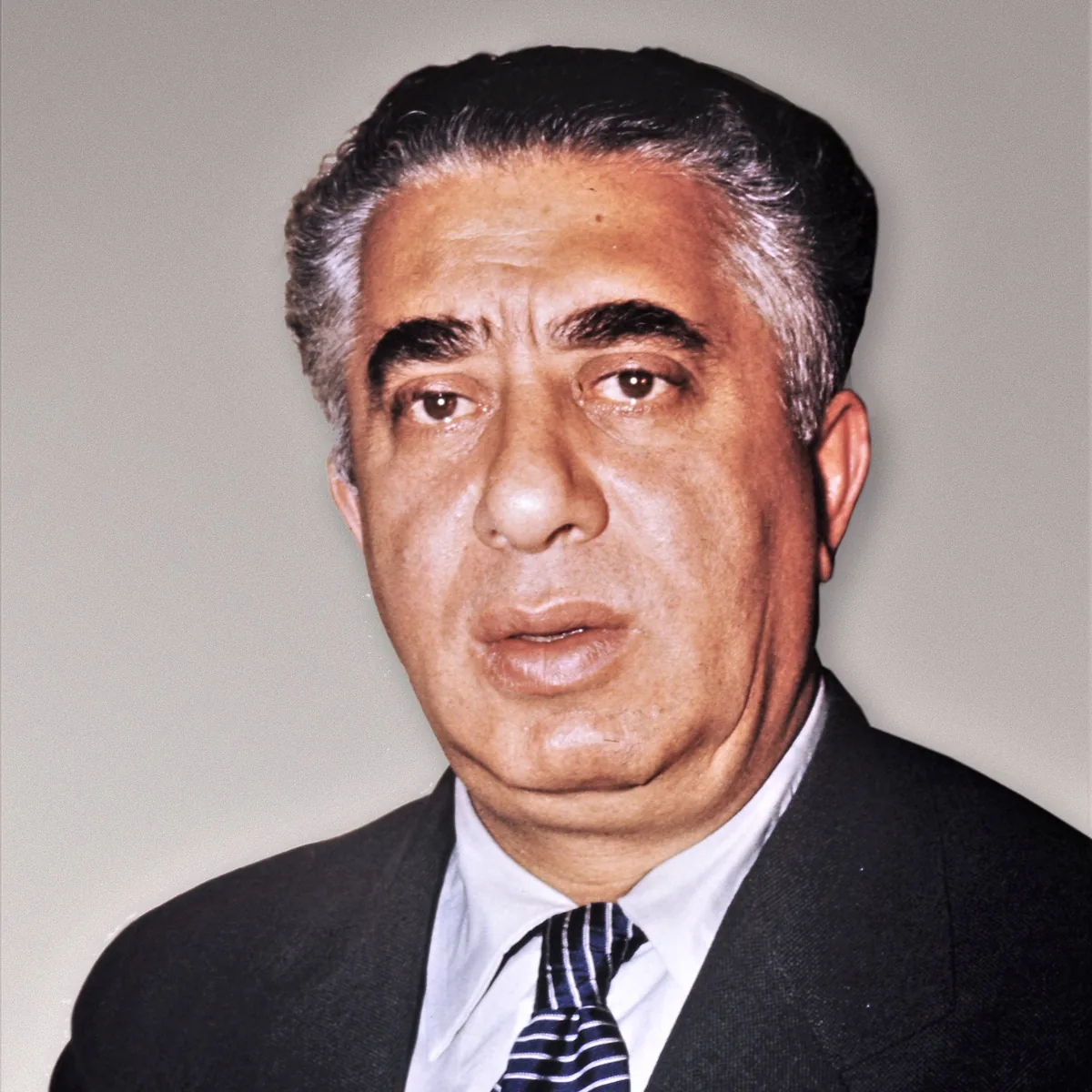
Khachaturian was born in Tiflis (now Tbilisi) in 1903 and died in Moscow in 1978. He studied at the Gnessin Institute and then at the Moscow Conservatory with Nikolai Myaskovsky. In 1948 he was denounced as a formalist together with Shostakovich and Prokofiev, but he was restored to favour later that year, and from 1957 he was secretary of the Union of Soviet Composers. His music draws on Armenian, Georgian and Azerbaijani folk music, including the ashugh (bard) tradition, and is known for ostinato rhythms, sensuous melody and vivid orchestration.
The Piano Concerto, written in 1936, was the first work to bring him recognition in the USSR and the West. Prokofiev, whose own First Piano Concerto is also in D-flat, advised him to write down ideas as they came and use them as building bricks for the whole. It is dedicated to the pianist Lev Oborin, who gave the first performance in Moscow on 12 July 1937 with the Moscow Philharmonic under Lev Steinberg.
It has three movements and is written in the grand manner of the Tchaikovsky and Rachmaninov concertos, with a sizable orchestra whose percussion includes side drum and military drum in the outer movements. It came before his Violin Concerto (1940) and Cello Concerto (1946).
What to listen for
- The first movement opens with a vehement orchestral summons, then the soloist announces the first theme; the second theme comes on the oboes, and a long cadenza in the piano's upper register leads to the coda.
- The slow movement, where a ruminative clarinet melody with strings gives way to a folk-inflected theme for violins and horn with an eerie flexatone (often played on a musical saw).
- The slow movement ends with the first theme on the clarinet and two pizzicato chords.
- The finale begins with an energetic "vamping" theme that turns ironic and farcical, then an unusually developmental cadenza, and a pulsating coda.
- Side drum and military drum in the outer movements that give the music a modern edge.
Sources: Aram Khachaturian (Wikipedia), Piano Concerto (Khachaturian) (Wikipedia), BIS Records booklet BIS-2586, notes by Andrew Barnett