1819–1880 · Romantic
Jacques Offenbach
1 work
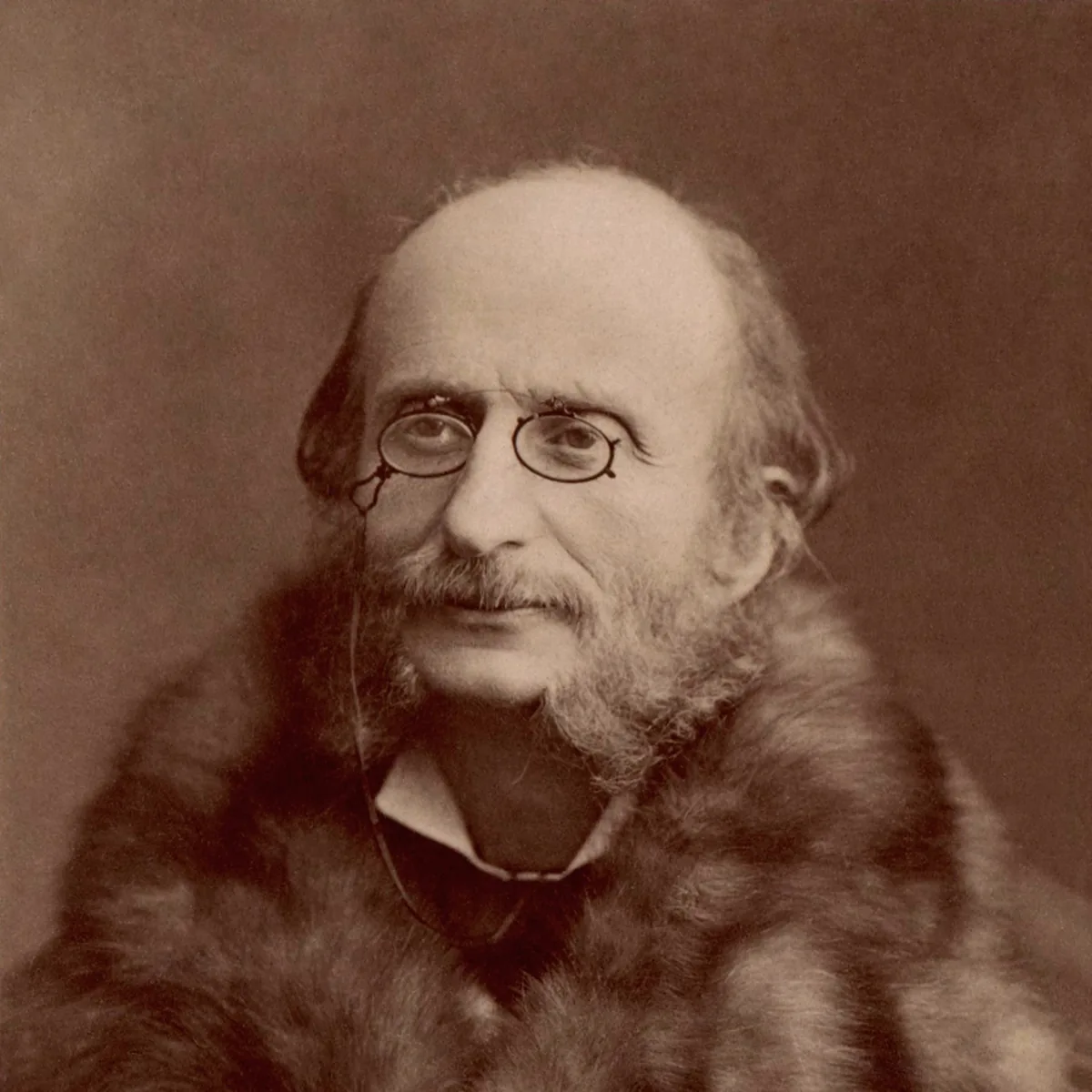
Offenbach was born in Cologne in 1819 and made his career in Paris as a cellist, conductor and theatre manager. In July 1855 he opened the Théâtre des Bouffes-Parisiens, where at first the licence limited casts to three characters, so he staged evenings of one-act pieces. He wrote nearly 100 operettas, and his operettas of the 1860s often poke fun at the court of Napoleon III under classical or modern disguise.
His melodies are short and seldom escape the four-bar phrase. The harmony is mostly built on tonic, dominant and subdominant chords, with quick swings between major and minor to change the mood. Variety comes from rhythm: fast patter set against smooth lines, and sweeping waltzes. His orchestras began with about 16 players and later reached about 30. His favourite joke is parody, familiar music turning up in an absurd setting, as when Orphée quotes Gluck and La Marseillaise.
Orpheus in the Underworld (Orphée aux enfers) opened at the Bouffes-Parisiens in October 1858 as his first full-length operetta and ran for 228 performances. The overture usually played today is not by Offenbach. Carl Binder arranged it for the 1860 production in Vienna, using tunes from the operetta, and it ends with the galop infernal, the tune later adopted for the can-can. Offenbach's own 1858 score has only a short introduction, and the longer overture he wrote for the 1874 revision is a different piece.
What to listen for
- Short, dance-like phrases that mostly fit into four bars.
- Quick swings between major and minor, used to change the mood within a few bars.
- Tunes from the operetta strung together in the overture, each with its own comic character, as in a parade of stage numbers.
- The galop infernal near the end, the tune that Paris cabarets later used for the can-can, with a driving, bouncing rhythm.
Sources: Jacques Offenbach (Wikipedia), Orpheus in the Underworld (Wikipedia), Orpheus in the Underworld, Overture (Kalmus/Alfred publisher note)