1782–1840 · Romantic
Niccolò Paganini
2 works
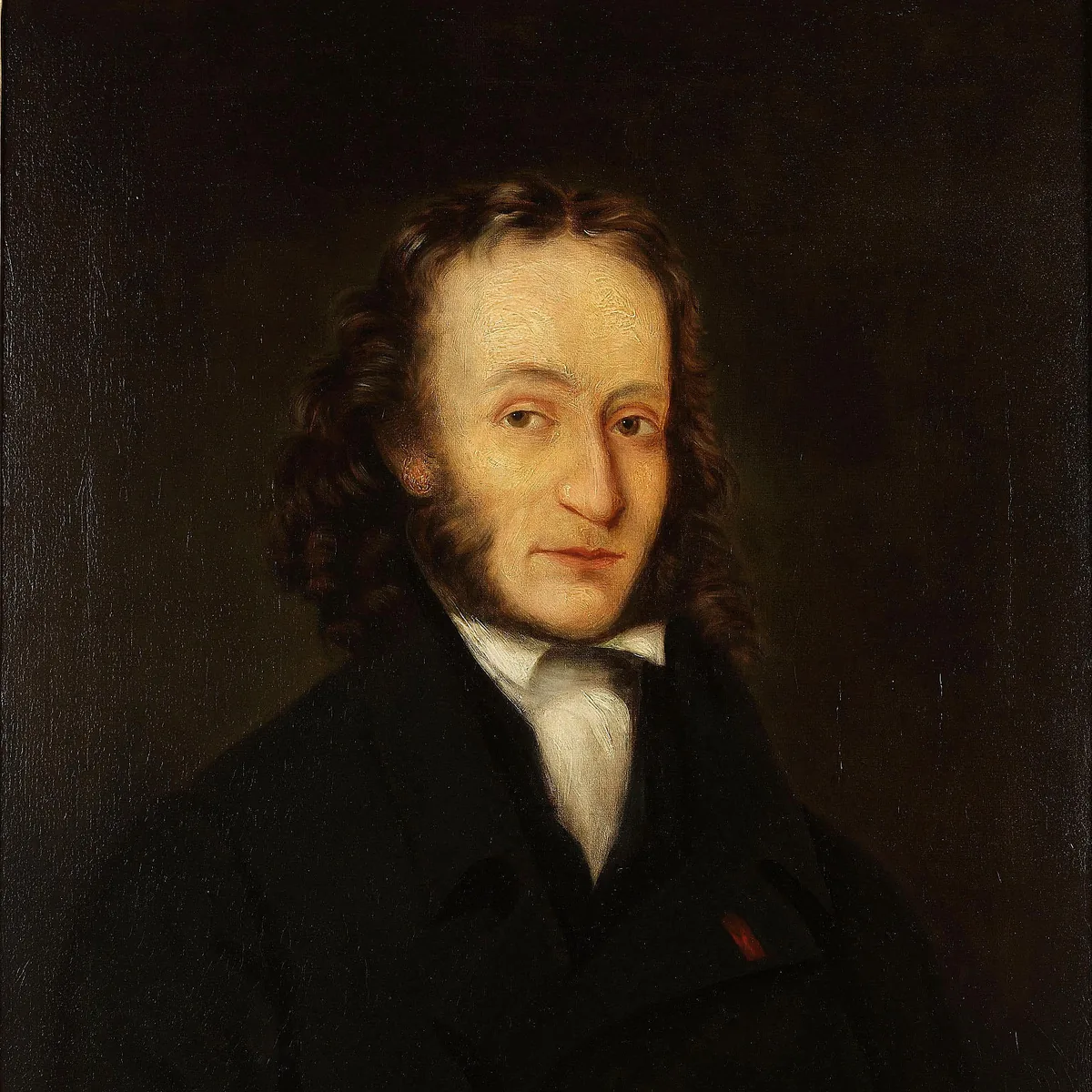
Paganini was born in Genoa in 1782 and died in Nice in 1840. He served the court of Elisa Baciocchi in Lucca from 1805, left in 1809 to work on his own, and from 1828 toured Europe as the leading violin virtuoso of his day. He wrote mainly for the violin and also played guitar. His six violin concertos date from 1817 to 1830.
His music is built around what the instrument can be made to do: left-hand pizzicato (plucking with the left hand), natural and artificial harmonics, and wide stretches that cover three octaves across four strings within one hand span. Liszt wrote six studies based on his works, Schumann wrote studies after the Caprices, and Brahms and Rachmaninoff both wrote variations on the A minor Caprice.
The 24 Caprices for solo violin, Op. 1, were written in groups of seven, five and twelve between 1802 and 1817 and published by Ricordi in Milan in 1820, dedicated to the artists. The last, in A minor, consists of a theme marked Quasi presto, followed by eleven variations and a finale. The variations use very fast scales and arpeggios, double and triple stops (two or three strings sounding at once), left-hand pizzicato, parallel octaves and tenths, rapid shifts and quick crossings between strings. Lutosławski and Blacher also wrote variations on the theme, and Liszt used it in one of his Paganini studies.
What to listen for
- A single theme that returns in the same outline under each variation, while the violinist's technique changes.
- Plucked notes from the left hand while the bow plays, which makes the violin sound like two instruments.
- Parallel octaves and tenths, where the violin plays two lines a fixed interval apart.
- Very fast scales, arpeggios and string crossings that run at speed without pause.
Sources: Niccolò Paganini (Wikipedia), Caprice No. 24 (Paganini) (Wikipedia), 24 Caprices for Solo Violin (Paganini) (Wikipedia)