1835–1921 · Romantic
Camille Saint-Saëns
9 works
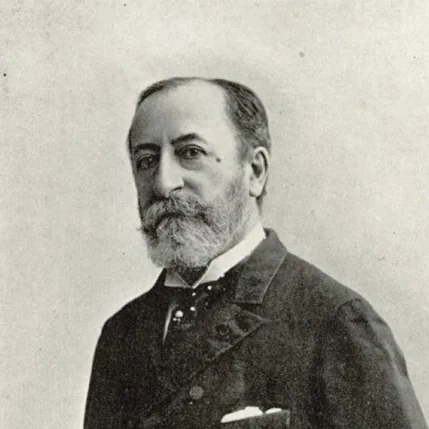
Saint-Saëns was born in Paris in 1835 and died in Algiers in 1921. He was organist at Saint-Merri and then, from 1858 until about 1877, at La Madeleine. He worked within classical forms and is noted for clear structure, orchestration and counterpoint. He admired Liszt, and his four symphonic poems follow Liszt's model.
Le Rouet d'Omphale (1871) was the first of them: Hercules spins wool for three years as Omphale's servant, and a spinning-wheel figure in the strings and woodwinds recurs throughout. Danse macabre (1874) began as a song on a poem by Henri Cazalis. A solo violin has its E string tuned down to E-flat, which gives a tritone, the interval once called the devil in music. A harp plays a single D twelve times for midnight, a xylophone imitates rattling bones, and the piece is built on a minor-key waltz. The Dies irae chant is quoted in a major key, and an oboe imitates a cockerel at dawn. The Symphony No. 3 (1886) was commissioned by the Philharmonic Society of London and dedicated to Liszt's memory. It has two parts of two movements, uses organ and piano, and moves from an agitated C minor to a triumphant C major.
The Cello Concerto No. 1 (1872) is one continuous movement in three sections: a single orchestral chord, then the cello states the main motif. The Violin Sonata No. 1 (1885) is rated by Grove as among his best and most characteristic works. Introduction and Rondo capriccioso (1863) was written for Sarasate. The wind sonatas of 1921, for oboe, clarinet and bassoon, were written to enlarge the repertoire for instruments with few solo works.
What to listen for
- In Danse macabre, the twelve strokes of midnight on the harp, the unsettled sound of the violin's lowered E string, the xylophone's rattling bones and the oboe's cockerel call.
- In Le Rouet d'Omphale, the spinning-wheel figure that comes round again and again.
- In the Organ Symphony, the entry of the organ, the piano used for both two and four hands, and the move from C minor to a C major finale.
- In the Cello Concerto, the cello entering after a single orchestral chord, and the brief minuet for muted strings in the middle.
- In the Introduction and Rondo capriccioso, a slow A minor introduction in which the orchestra plays block chords while the violin plays arpeggios and chromatic scales.
Sources: Camille Saint-Saëns (Wikipedia), Danse macabre (Saint-Saëns) (Wikipedia), Le Rouet d'Omphale (Wikipedia), Symphony No. 3 (Saint-Saëns) (Wikipedia), Cello Concerto No. 1 (Saint-Saëns) (Wikipedia), Introduction and Rondo Capriccioso (Wikipedia)
Works
 Saint-SaënsIntroduction and Rondo capriccioso, Op. 28Saint-SaënsLe Rouet d’Omphale, Op. 31Saint-SaënsCello Concerto No. 1 in A minor, Op. 33Saint-SaënsDanse macabre, Op. 40Saint-SaënsPiano Concerto No. 4 in C minor, Op. 44Saint-SaënsViolin Sonata No. 1 in D minor, Op. 75Saint-SaënsSymphony No. 3 in C minor, Op. 78Saint-SaënsClarinet Sonata in E-flat major, Op. 167Saint-SaënsOboe Sonata in D major, Op. 166