1874–1951 · Modern
Arnold Schoenberg
1 work
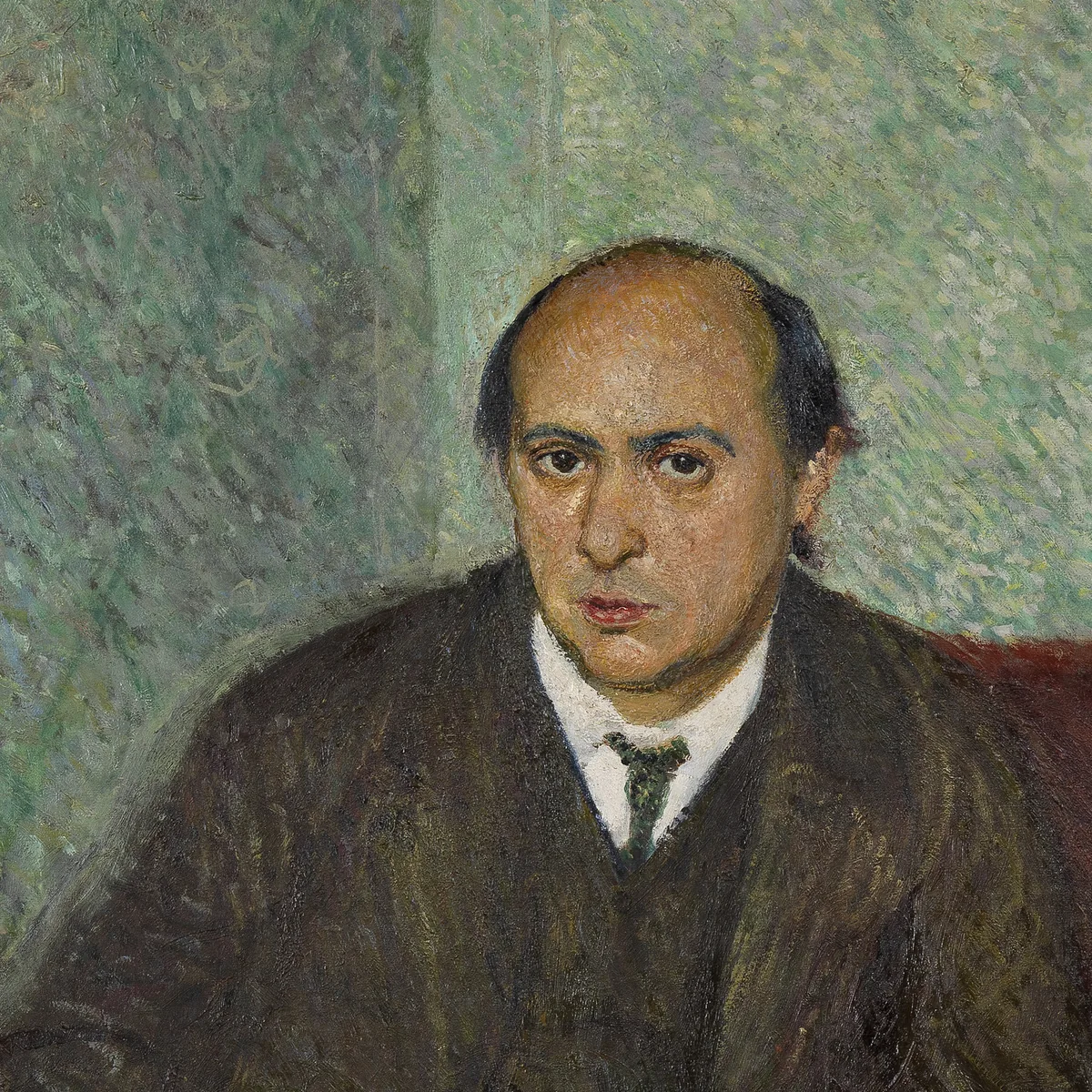
Schoenberg was born in Vienna and worked there and in Berlin. He left Germany in 1933 and finished his career teaching in Los Angeles. His music is usually described in three stages. Until about 1908 he wrote in a late Romantic style that joins Brahms's closely worked motifs to Wagner's chromatic harmony. After that he gave up a home key, and from 1923 he organised his music by a twelve-tone method, in which the twelve notes are related only to one another. His pupils Anton Webern and Alban Berg, with him, are called the Second Viennese School.
Verklärte Nacht (Transfigured Night), Op. 4, belongs to the first stage. He wrote it in 1899 in about three weeks, for string sextet: two violins, two violas and two cellos. It follows a poem by Richard Dehmel in which a man and a woman walk through a dark wood by moonlight. She confesses that she carries another man's child, and he accepts her. The music falls into five sections that match the poem's stanzas, and its themes work as musical equivalents of the story. Schoenberg arranged it for string orchestra in 1917 and revised that version in 1943; the orchestral form is the one most often played.
The harmony is the point of interest. The piece is rooted in D minor but travels far from it, with chromatic chords descended from Wagner's Tristan und Isolde. Long stretches grow by constantly varying a few small motifs, a technique Schoenberg learned from Brahms. Phrases often cut across the bar lines. At the Vienna premiere in 1902 an unusual inverted ninth chord caused a dispute.
What to listen for
- Follow the poem: the music moves from the woman's confession to the man's acceptance, in five connected sections without a break.
- Chromatic harmony, where chords slide by small steps and the music rarely settles, although D minor stays in the background.
- Small motifs that return again and again, each time changed in rhythm, pitch or instrument.
- Phrases that run over the bar lines, so the beat is hard to pin down.
Sources: Verklärte Nacht (Wikipedia), Arnold Schoenberg (Wikipedia)