1852–1909 · Romantic
Francisco Tárrega
1 work
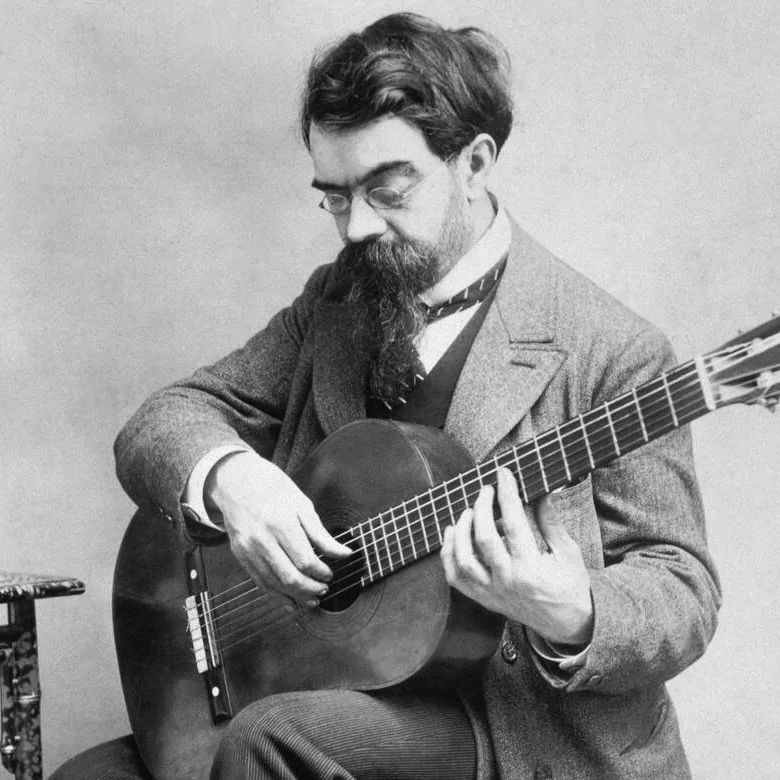
Tárrega was born in Villarreal in the province of Castellón and died in Barcelona. He entered the Madrid Royal Conservatory in 1874, where Emilio Arrieta persuaded him to give up piano for guitar. He valued guitars by the Seville maker Antonio de Torres, whose sound inspired his playing. His pupils included Emilio Pujol, Miguel Llobet and Daniel Fortea, and in Barcelona his friends included Albéniz, Granados and Casals. He is often credited with laying the foundations of twentieth-century classical guitar.
A large part of his work is transcription: he arranged piano music by Beethoven, Chopin, Mendelssohn and Albéniz for the guitar. His own pieces include Lágrima, Capricho árabe, Recuerdos de la Alhambra (1896) and Oremus, his last work. Around 1902 he cut his fingernails and developed a sound that became typical of his school.
Recuerdos de la Alhambra, a memory of a visit to the Alhambra palace in Granada, was first titled Improvisación ¡A Granada! Cantiga Árabe and dedicated to his patron Concepción Gómez de Jacoby, who took him there. The sources disagree on whether it dates from 1896 or 1899. It rests on the tremolo: one melody note is plucked in quick succession by three fingers, so it sounds like a single sustained note, while the thumb plays an arpeggio accompaniment. The first section is in A minor and the second in A major.
What to listen for
- The tremolo: one note repeated so fast that it sounds held, forming the melody.
- The thumb's flowing arpeggios beneath it. Listeners who only hear the piece often take it for a duet.
- The change from A minor to the brighter A major in the second section.
Sources: Francisco Tárrega (Wikipedia), Recuerdos de la Alhambra (Wikipedia)