1786–1826 · Romantic
Carl Maria von Weber
5 works
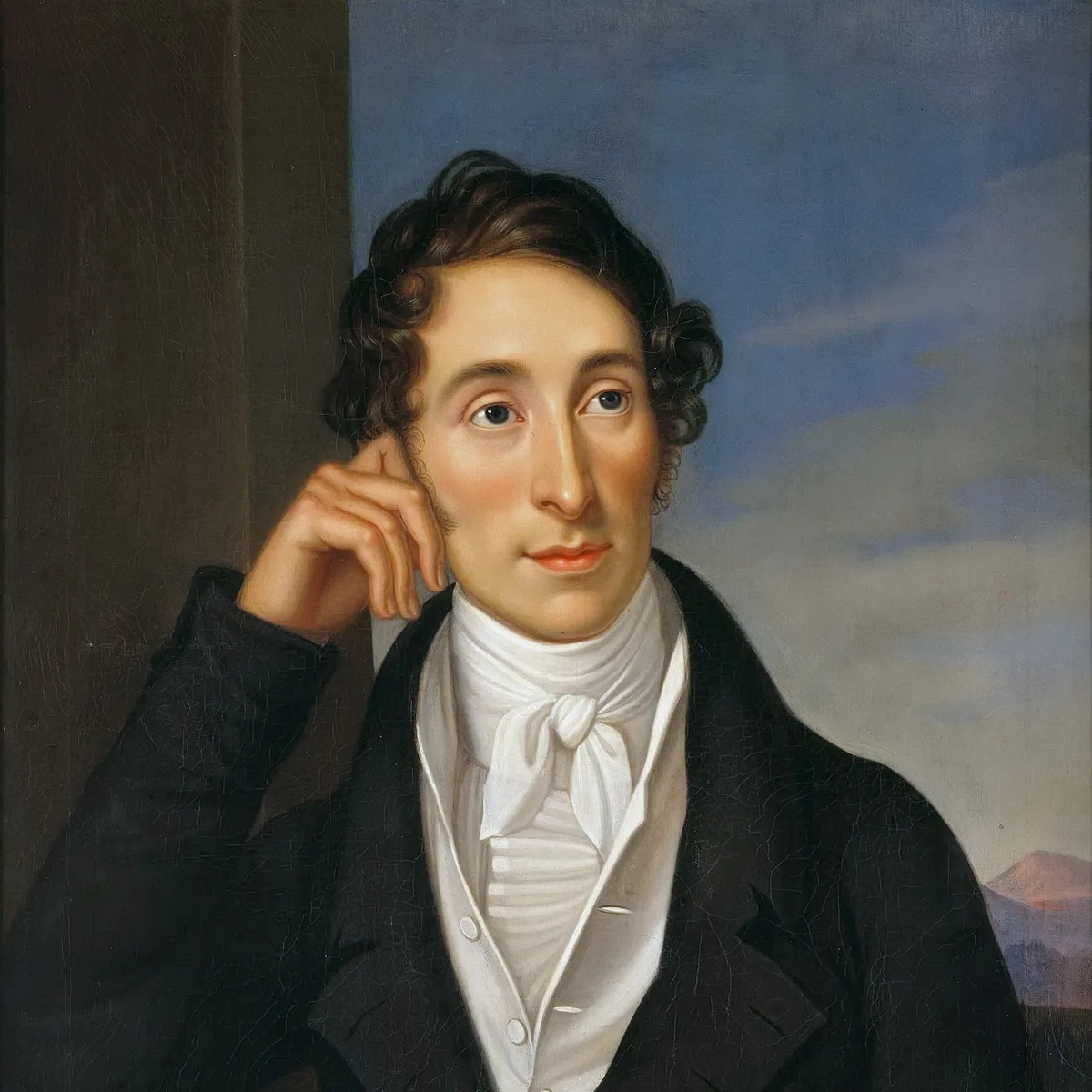
Weber was born in Eutin and worked as an opera director in Breslau, Prague, and, from 1817, Dresden, where he worked to establish German opera against Italian. Der Freischütz, first given in Berlin on 18 June 1821, spread across Europe. Oberon, written for Covent Garden in London in English, premiered on 12 April 1826, and he died in London on 5 June. Berlioz and Debussy praised his orchestration, and in Euryanthe he used recurring musical themes that anticipate Wagner.
The two overtures are built from the operas' own themes. The Freischütz overture opens with a slow introduction in which a horn quartet evokes the forest, the evil spirit Samiel is shown by a string tremolo and soft timpani throbs, and the quick section turns stormy for the Wolf's Glen scene. A long clarinet solo leads to the soaring theme of the heroine, Agathe, and the overture ends joyfully. The Oberon overture draws on the opera's magic horn call and a soprano aria; the opera's fairy music is delicately orchestrated and anticipates Mendelssohn.
In 1811 in Munich he wrote for the clarinettist Heinrich Baermann (also spelled Bärmann). The Concertino in E-flat, Op. 26, is a single movement, and the two concertos, No. 1 in F minor, Op. 73, and No. 2 in E-flat, Op. 74, are in three movements. The writing is operatic: lyrical slow music, recitative-like exchanges with the orchestra, and wide leaps from the low register to the very high.
What to listen for
- In the Freischütz overture, the horn quartet's forest music, the tremolo and timpani throbs of Samiel, and the clarinet's theme for Agathe.
- In the Oberon overture, themes from the opera, including the magic horn call and a soprano aria.
- In Clarinet Concerto No. 1, the Adagio, where a horn trio plays alone in the middle and the clarinet answers as an opera singer would.
- In Concerto No. 2, the huge leaps of the first movement and the playful, dotted and syncopated rhythm of the closing Alla Polacca.
- In the Concertino, a slow introduction in C minor, then a theme with variations, according to Wikipedia and one arranger's note.
Sources: Carl Maria von Weber (Wikipedia), Clarinet Concerto No. 1 (Weber) (Wikipedia), Clarinet Concerto No. 2 (Weber) (Wikipedia), Concertino for Clarinet (Weber) (Wikipedia), Oberon (Weber) (Wikipedia), Der Freischütz overture program notes (Bard College Conservatory)