1910–1981 · Modern
Samuel Barber
4 works
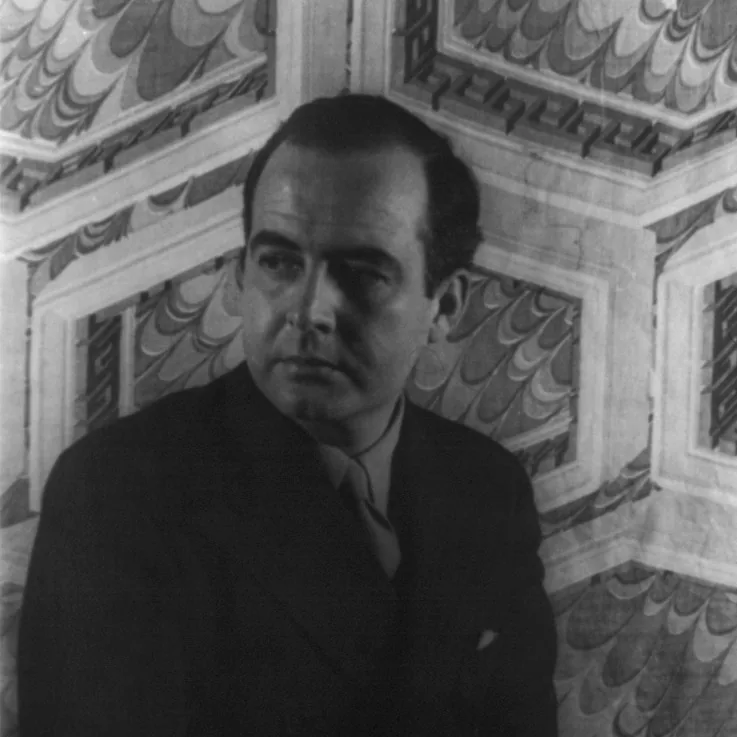
Barber, born in West Chester, Pennsylvania, was a pianist, baritone and conductor as well as a composer. His language is tonal and song-like, built on nineteenth-century harmony rather than modernist methods. After about 1940 he allowed more dissonance and chromatic writing, as in the Cello Concerto of 1945 and the Piano Sonata of 1949.
The Adagio for Strings (1936) is the string-orchestra version of the slow movement of his String Quartet, Op. 11. It is in B-flat minor with modal touches. It begins softly on a single note in the first violins, and the melody climbs and falls by step in a long arch. Four loud chords mark the peak, a long pause follows, and the opening returns and fades on an unresolved chord. Toscanini and the NBC Symphony gave the first performance on radio in November 1938.
Knoxville: Summer of 1915 (1947) sets selected passages of James Agee's prose recollection of a childhood summer evening, for soprano and orchestra. Eleanor Steber commissioned it and sang the first performance with the Boston Symphony under Koussevitzky in 1948. Barber called it a lyric rhapsody. The Piano Concerto, Op. 38, was first played by John Browning at the opening of Philharmonic Hall in 1962. It has three movements: an Allegro appassionato, a Canzone adapted from a 1959 flute elegy, and a finale in 5/8 over a pounding ostinato with heavy brass.
What to listen for
- In the Adagio, follow the single line as it climbs by step. The four loud chords and the silence after them mark the peak before the opening returns.
- In Knoxville, the soprano's long lyrical lines over soft woodwind and a rocking harp figure, and the sudden agitated section that interrupts the opening mood.
- In the Piano Concerto, the 5/8 finale, where the orchestra hammers a five-beat pulse under the soloist.
- The Canzone of the concerto grows from a single melody, a reminder of how song-like Barber's slow music is.
Sources: Samuel Barber (Wikipedia), Adagio for Strings (Wikipedia), Knoxville: Summer of 1915 (Wikipedia), Piano Concerto (Barber) (Wikipedia)