1857–1934 · Late Romantic
Edward Elgar
3 works
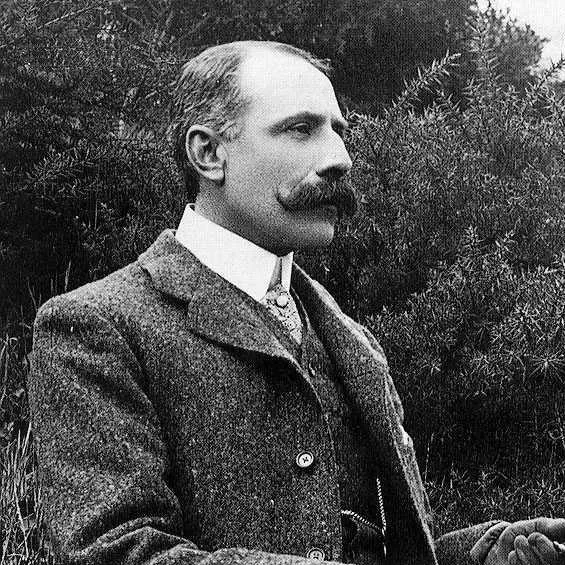
Elgar was born in Lower Broadheath near Worcester, raised a Roman Catholic and largely self-taught. He was knighted in 1904 and made Master of the King's Musick in 1924. His influences were mostly continental: Handel, Dvořák and Brahms, Wagner for his chromatic harmony, and French music for his orchestration. Later commentators link his orchestral writing to the Central European tradition of Richard Strauss.
The Enigma Variations were written between October 1898 and February 1899 and first performed on 19 June 1899 at St James's Hall, London, under Hans Richter. The G minor theme (Andante) is followed without a break by 14 variations, each headed by the initials or nickname of a friend, the last being Elgar himself. "Nimrod" pictures August Jaeger, who persuaded him to enlarge the finale; about 96 bars and an optional organ part were added. Elgar never revealed the "enigma", a larger theme that he hinted runs through the work without being played.
Pomp and Circumstance March No. 1 dates from 1901 and was first heard in Liverpool on 19 October 1901. It is a march with a trio. The trio tune became "Land of Hope and Glory", with words by A. C. Benson added in the Coronation Ode of 1902. The march opens with a brisk introduction and ends with a short reminder of the opening march rather than the big tune. The orchestra includes two harps and an organ.
What to listen for
- The G minor Enigma theme at the start. Then hear how each variation, headed by a friend's initials, changes its mood.
- "Nimrod": the slow variation that portrays August Jaeger.
- The enlarged finale, which adds an organ part.
- In Pomp and Circumstance No. 1, the brisk march, the broad trio tune, and the short return of the march at the end.
Sources: Edward Elgar (Wikipedia), Enigma Variations (Wikipedia), Pomp and Circumstance Marches (Wikipedia)