1839–1881 · Romantic
Modest Mussorgsky
3 works
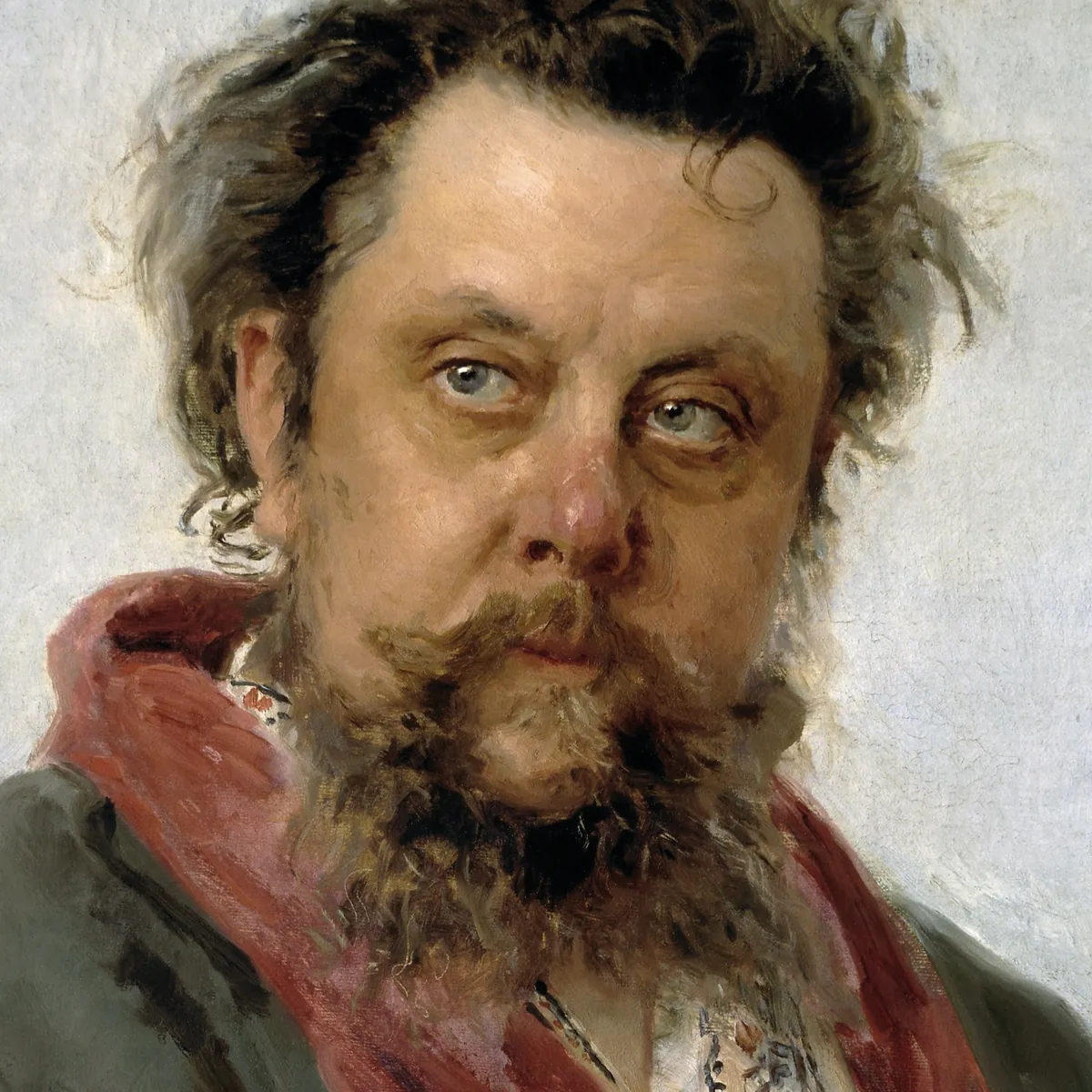
Mussorgsky was born at Karevo in the Pskov region of Russia and spent his working life in Saint Petersburg, supporting himself as a low-ranking civil servant. He had little formal training: Mily Balakirev taught him musical form, and he belonged to the Five, a circle of Russian nationalist composers around Balakirev. Much of his music draws on Russian history, folklore and church music, and his songs and operas follow the natural rhythm and rise and fall of Russian speech.
He ignored textbook rules that he considered outdated. His harmony is bold, with modal scales from folk song and Orthodox chant, chords built in fourths and unexpected progressions, and his phrases and metres are often irregular. After his death Rimsky-Korsakov edited much of his music, smoothing its harmony, rhythm and form; these versions made the works known, but many performers now prefer Mussorgsky's own texts.
Both forms of Night on Bald Mountain show this. Mussorgsky finished the orchestral piece St John's Eve on Bald Mountain on 23 June 1867, picturing a witches' sabbath in four stages: the witches gather, Satan's procession, a black mass, and the sabbath. Balakirev criticised it harshly, and it was neither performed in Mussorgsky's lifetime nor printed until 1968. He later reused the music in two stage projects, and in 1886 Rimsky-Korsakov turned the last of these into an orchestral fantasy whose ending, a church bell that scatters the spirits before dawn, comes from that last version. Pictures at an Exhibition, written for piano in June 1874, portrays drawings and designs by his friend Viktor Hartmann, shown in a memorial exhibition after Hartmann's sudden death in 1873.
What to listen for
- The 1867 original has no dawn: it stays with the sabbath to the end, and its harmony and scoring are harsher than in the later version.
- In Rimsky-Korsakov's version, listen for the bell near the end: the wild dance breaks off and quiet music for daybreak follows.
- In Pictures, the Promenade tune, in changing metres and marked to be played 'in the Russian manner', returns transformed inside Catacombae and in The Great Gate of Kiev.
- In Bydło, the piano original begins loudly, with the ox cart right in front of you, and fades as it moves away.
- Samuel Goldenberg and Schmuÿle sets two figures side by side, a grave, heavy theme for the rich man and a lighter one for the poor man, and then plays them together.
Sources: Modest Mussorgsky (Wikipedia), Мусоргский, Модест Петрович (Russian Wikipedia), Night on Bald Mountain (Wikipedia), Pictures at an Exhibition (Wikipedia)