1685–1757 · Baroque
Domenico Scarlatti
1 work
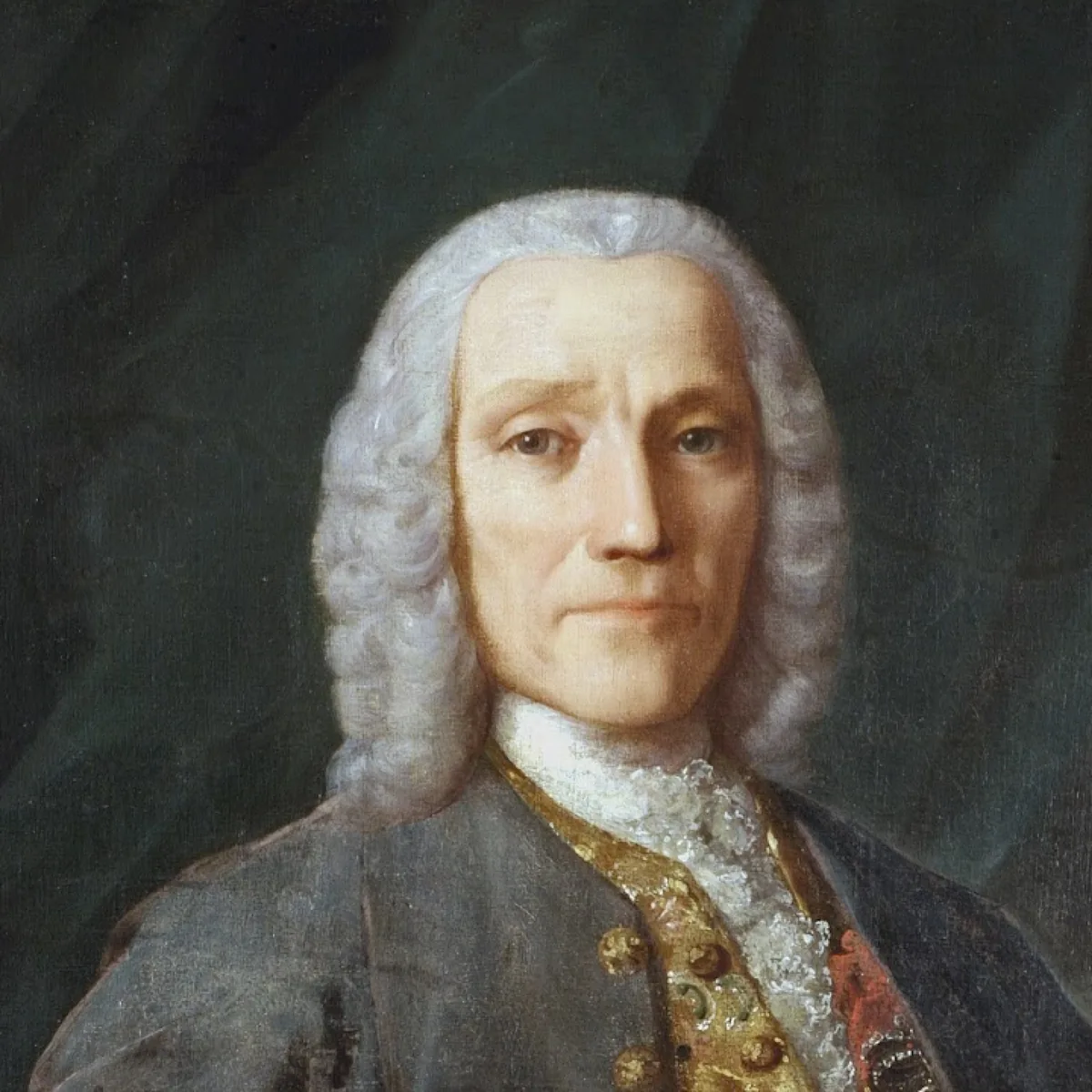
Scarlatti was born in Naples, the son of the opera composer Alessandro Scarlatti. He worked in Rome, then in Lisbon from 1719 as music director to King John V of Portugal. When the Portuguese princess Maria Barbara went to Spain, he followed her to Seville in 1729 and to Madrid in 1733. Most of his keyboard sonatas were written for her.
He left about 555 sonatas, nearly all in one movement and mostly in two-part (binary) form: a first half that leaves the home key and a second half that answers it. Each half is repeated. Thirty of them appeared in print as the Essercizi in 1738, apparently under his supervision, but most went unpublished in his lifetime. Iberian folk music shaped the style: guitar-like strumming and repeated notes, the Phrygian mode, bold dissonance, and sudden modulations to distant keys. The K. numbers come from Ralph Kirkpatrick's 1953 catalogue and are now standard; the older L. numbers belong to Alessandro Longo's edition.
Sonata K. 141 in D minor (L. 422) is a fast piece in 3/8 built on rapid repeated notes, so the keyboard sounds like a plucked instrument. It uses hand crossing, trills and syncopated rhythms drawn from Spanish dance music. Some players call it a toccata because it displays finger technique. It is a single movement in binary form, as is typical of the sonatas.
What to listen for
- The same note struck again and again at speed, like a strummed guitar. This is the sound of K. 141.
- Hand crossing: one hand leaps over the other to reach a distant note, and you can hear the wide jump in the line.
- The two-part plan: the first half moves away from D minor and is repeated, then the second half answers it, also with a repeat.
- Syncopation and sudden harmonic turns that give the piece its Spanish, dance-like edge.
Sources: Domenico Scarlatti (Wikipedia), Keyboard Sonata, K. 141 (Scarlatti) (Wikipedia)