1865–1957 · Late Romantic
Jean Sibelius
7 works
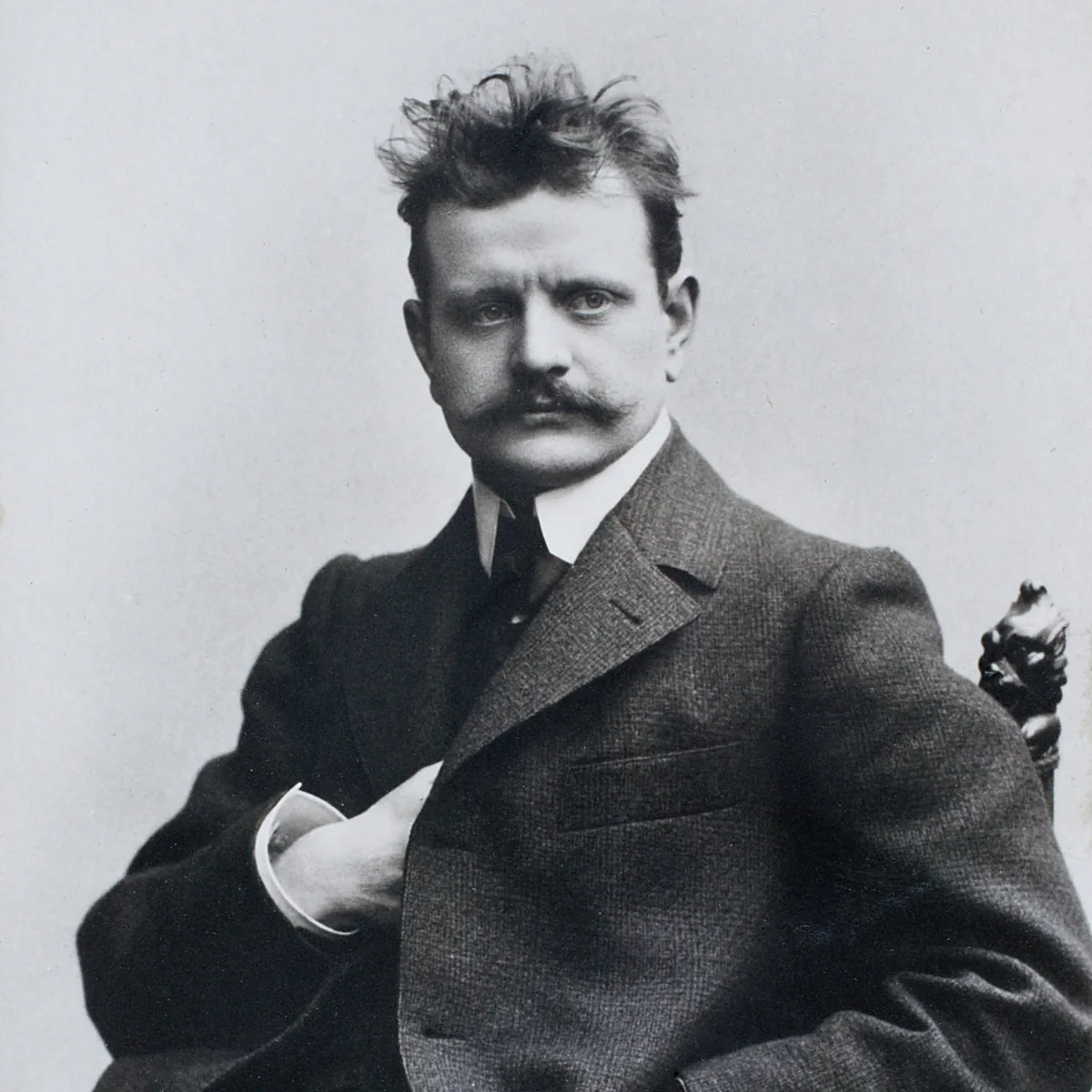
Sibelius was born in Hämeenlinna, in the Grand Duchy of Finland under Russian rule, and died at Ainola in Järvenpää. His music helped shape a Finnish national identity, and many works draw on the Kalevala, the Finnish epic. The Swan of Tuonela (1893 to 1895) began as the prelude to a planned opera and became part of the Lemminkäinen Suite. In the programme, the hero Lemminkäinen is sent to kill a mystical swan floating through Tuonela, the realm of the dead, and is himself killed.
His mature style plays down the familiar markers of sonata form. He builds from small cells of three or four notes that grow and accumulate into a large statement. Tempos are often slow, and his brass writing has been compared to Bruckner's. Valse triste (1903, revised 1904) was incidental music for his brother-in-law's play Kuolema (Death), in which a dying woman rises to dance with ghosts. The Violin Concerto (1903 to 1904, revised 1905) was first played in 1904, then withdrawn and revised.
The Seventh Symphony (1924) is a single movement centred on C major, with a trombone theme that returns at key moments. Tapiola (1926), written for the New York Symphony Society, portrays Tapio, the forest spirit of the Kalevala, in B minor and from one core motif. After it Sibelius wrote few major works, a retirement known as the silence of Järvenpää.
What to listen for
- In The Swan of Tuonela, the cor anglais (English horn) as the swan's voice, floating above divided strings in a very slow 9/4.
- In Valse triste, a slow waltz that follows the stage scene of a dying woman dancing with ghosts.
- In the Violin Concerto, the soloist entering over pianissimo strings, a long cadenza in place of a development section in the first movement, and a finale that Tovey jokingly called a "polonaise for polar bears".
- In Symphony No. 7, one continuous span in which the trombone theme returns and keeps affirming C major; it ends on an abrupt C major chord.
- In Tapiola, a single motif reworked again and again, from an opening marked Largamente.
Sources: Jean Sibelius (Wikipedia), The Swan of Tuonela (Wikipedia), Valse triste (Wikipedia), Violin Concerto (Sibelius) (Wikipedia), Symphony No. 7 (Sibelius) (Wikipedia), Tapiola (Sibelius) (Wikipedia)