1811–1886 · Romantic
Franz Liszt
35 works
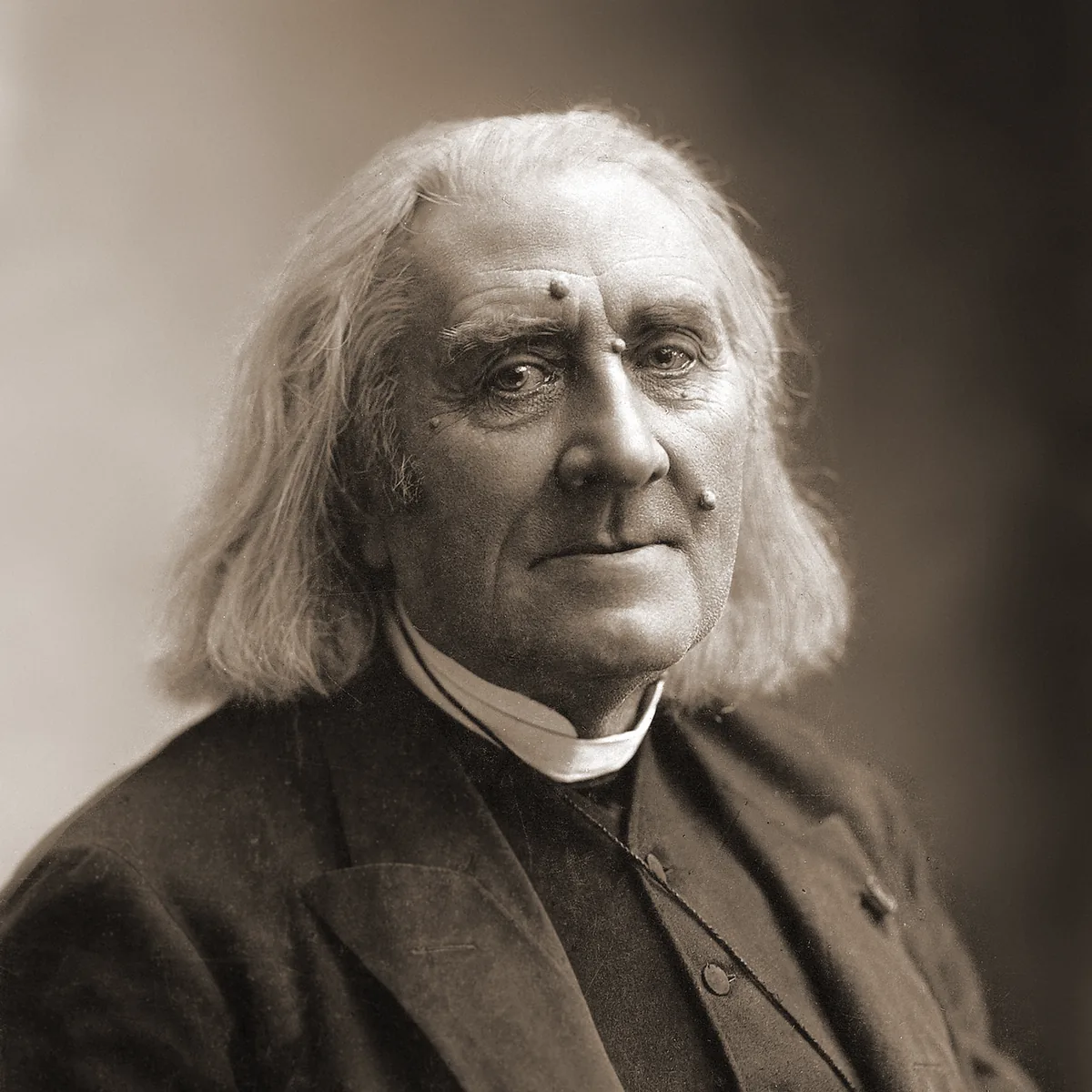
Liszt was born in 1811 in Doborján (now Raiding, Austria), then in the Kingdom of Hungary, and died in Bayreuth in 1886. He toured Europe as a pianist in the 1830s and 1840s, gave up the concert stage in 1847, and was court kapellmeister in Weimar from 1848 to 1861. He took minor orders in 1865 and was known as Abbé Liszt. He invented the symphonic poem, a single-movement orchestral piece based on a literary or pictorial source, and he developed thematic transformation, in which a theme returns again and again with a changed character.
The catalog shows both sides of his output. The orchestral works include the symphonic poems Tasso, Les Préludes, Orpheus, Prometheus, Mazeppa, Festklänge and Hamlet, written mostly in Weimar between 1848 and 1858; his prefaces give a general mood rather than a story to follow. The Faust Symphony (1854) paints Faust, Gretchen and Mephistopheles in three movements, and Mephistopheles has no themes of his own but distorts Faust's. The Dante Symphony has two movements, Inferno and Purgatorio, because Wagner argued against a Paradiso. With piano and orchestra there are two concertos, No. 2 a single movement in six sections, and Totentanz, variations on the Dies irae chant.
The solo piano music ranges from the B minor Sonata, one movement of about thirty minutes, to the Années de pèlerinage (Swiss and Italian pieces inspired by landscape, Raphael, Petrarch and Dante), the Harmonies poétiques et religieuses, the Transcendental and Paganini studies, Hungarian Rhapsodies in a slow-then-fast pattern that imitates the cimbalom, and nocturne-like pieces such as the Liebesträume and Consolations.
What to listen for
- Thematic transformation: in the Faust Symphony, Mephistopheles twists Faust's themes into ironic versions, while Gretchen's theme stays intact.
- In the B minor Sonata, the opening descending scale, the jagged octave motif, the single-note "hammer-blow" theme, and the quiet ending.
- In the Hungarian Rhapsodies, a slow, free first part followed by a fast dance, with the piano imitating the cimbalom.
- In Totentanz, variations on the Dies irae, with toccata-like repeated notes in the piano and strings played with the wood of the bow to suggest clattering bones.
- In Funérailles, bell-like chords over low tremolos, a funeral march, a heroic march with bass octaves, and quiet detached chords at the end.
- In the Transcendental and Paganini studies, technical display as the point: wide leaps, rapid octaves, scales and arpeggios, and in La campanella a theme taken from the finale of Paganini's Second Violin Concerto.
Sources: Franz Liszt (Wikipedia), Symphonic poems (Liszt) (Wikipedia), A Faust Symphony (Wikipedia), Dante Symphony (Wikipedia), Piano Sonata (Liszt) (Wikipedia), Piano Concerto No. 1 (Liszt) (Wikipedia), Piano Concerto No. 2 (Liszt) (Wikipedia), Totentanz (Liszt) (Wikipedia), Années de pèlerinage (Wikipedia), Harmonies poétiques et religieuses (Wikipedia), Funérailles (Wikipedia), Transcendental Études (Wikipedia), Grandes études de Paganini (Wikipedia), Hungarian Rhapsodies (Liszt) (Wikipedia), Mephisto Waltzes (Wikipedia), Ballade No. 2 (Liszt) (Wikipedia), Liebesträume (Wikipedia), Consolations (Liszt) (Wikipedia), Two Concert Études (Liszt) (Wikipedia)
Works
 LisztSonetto 104 del Petrarca, S. 161/5LisztHungarian Rhapsody No. 2 in C-sharp minor, S. 244/2LisztHungarian Rhapsody No. 6 in D-flat major, S. 244/6LisztHungarian Rhapsody No. 12 in C-sharp minor, S. 244/12LisztAprès une lecture du Dante: Fantasia quasi Sonata, S. 161/7LisztFunérailles, S. 173/7LisztPiano Concerto No. 1 in E-flat major, S. 124LisztSposalizio, S. 161/1LisztTasso, Lamento e Trionfo, S. 96LisztTotentanz, S. 126LisztConsolation No. 3 in D-flat major, S. 172 No. 3LisztLiebestraum No. 3 in A-flat major, S. 541 No. 3 / R. 211LisztGrandes études de Paganini No. 6 in A minor, S. 141/6LisztLa campanella (Grandes études de Paganini No. 3 in G-sharp minor), S. 141/3LisztTranscendental Etude No. 4 in D minor, S. 139/4LisztTranscendental Etude No. 5 in B-flat major, S. 139/5LisztTranscendental Etude No. 10 in F minor, S. 139/10LisztTranscendental Etude No. 11 in D-flat major, S. 139/11LisztBallade No. 2 in B minor, S. 171LisztBénédiction de Dieu dans la solitude, S. 173/3LisztFestklänge, S. 101LisztPiano Sonata in B minor, S. 178LisztA Faust Symphony, S. 108LisztLes Préludes, S. 97LisztMazeppa, S. 100LisztOrpheus, S. 98LisztVallée d'Obermann (Années de pèlerinage I), S. 160/6LisztPrometheus, S. 99LisztDante Symphony, S. 109LisztHunnenschlacht, S. 105LisztHamlet, S. 104LisztMephisto Waltz No. 1, S. 514LisztPiano Concerto No. 2 in A major, S. 125LisztGnomenreigen, S. 145 No. 2LisztSt. Francis of Paola Walking on the Waves, S. 175/2