Path 13
The art song, from Schubert to Strauss
A poem, a voice and a piano, later an orchestra: from Schubert's first masterpieces to Strauss's last songs.
Schubert → Schumann → Wagner → Mahler → Debussy → Fauré → Strauss
This guide follows Schumann’s Dichterliebe, Op. 48 (1840) in 16 parts: Im wunderschönen Monat Mai, Aus meinen Tränen sprießen, Die Rose, die Lilie, die Taube, die Sonne, Wenn ich in deine Augen seh', Ich will meine Seele tauchen, Im Rhein, im heiligen Strome, Ich grolle nicht, Und wüßten's die Blumen, die kleinen (theme and variations), Das ist ein Flöten und Geigen, Hör' ich das Liedchen klingen, Ein Jüngling liebt ein Mädchen, Am leuchtenden Sommermorgen, Ich hab' im Traum geweinet, Allnächtlich im Traume, Aus alten Märchen winkt es and Die alten, bösen Lieder.
1 Im wunderschönen Monat Mai · 4 sections
A short piano sets a hesitant, wistful mood before the voice enters with Heine's first , about the May when love awoke. Although the words speak of delight, the music opens on an aching dissonance and sounds nostalgic. The second follows. In the the piano is left alone and ends on a chord that expects a home which never comes, so the song hangs open and leads straight into the next.
Four- phrases give this song a compact shape: the melody is heard in A1 and again in A2, a contrasting (B) arrives, and the opening melody in A3. The poet offers her flowers grown from his tears and nightingale songs born of his sighs, if she will only love him. The voice finishes first; then the piano completes the alone.
Words come quickly here, set almost syllable by syllable in a continuous flow from the start, as the poet lists the rose, the lily, the dove and the sun, all things he once loved. Then the accompaniment moves into a lower . Near the end the voice puts its weight on the last words, where he says that now he loves only one, and then the starts.
Four phrases follow each other, each lifting the feeling a little higher. Looking into her eyes eases the poet's pain, yet when she says she loves him he weeps. A turn to C major marks the second and a turn to E minor the fourth, where the comes. Then the begins. In his own copy of Heine, Schumann dated this poem 8 February 1836, the day he saw Clara again after a long separation.
Two stanzas share one repeating accompaniment pattern: the first opens the song and the second follows with the pattern continuing. The poet imagines dipping his soul into the cup of a lily, which will sing a song of his love. After the voice ends, the dwells on the memory of that sweet hour.
Slow, hymn-like chords in the opening suggest a cathedral organ, while the right hand ripples like the river that mirrors Cologne Cathedral. The second follows, and a passage of diminished-seventh harmony, the , leads into the third, where the poet sees in the cathedral a face that resembles that of the woman he loves. The voice closes, and the long brings back the opening material.
The poet insists that he bears no grudge, even though his heart is breaking. The first part makes this case; the second part with greater intensity in voice and piano. A final shock chord ends the song abruptly. Livia Frege and Clara Schumann gave it its first public hearing in December 1844, and it soon circulated on its own.
Four stanzas (Strophes I to IV) tell how flowers, nightingales and stars would share his grief if they knew it, but only she knows what she has done. Very fast fluttering notes in the piano suggest birdsong and starlight. The fourth varies the pattern and settles more firmly on the home . The agitated conveys speechless rage and despair.
A jealous mind hears the wedding band: flutes and violins play dance music, while repeated bass notes keep returning like an obsession. I opens the song, a leads to the varied second , and the poem ends with cupids sobbing among the festivities. The long brings back the , and a descent sinks to the .
A four- piano is followed by the voice. The poet hears a little song that she once sang, and it overwhelms him so that he goes up into the forest to weep. After the voice ends, an eleven- begins, a sorrowful comment from the piano, and then the music speeds up as it falls away.
After a four- the voice tells an old story: a young man loves a girl who has chosen someone else, and the poem remarks that such a story is old yet always new. Later the changes, and the harmonic high point arrives with the last vocal . The follows, grows more accented, and a draws it out to the end.
The first sets a garden scene on a bright summer morning, in which the flowers speak to the poet and urge him not to be harsh. Then the music slows for the rest of the poem. A ten- follows and has the last word.
The poet dreams that he has lost the woman he loves and wakes in tears. In the first the voice declaims almost like with the piano answering; Eric Sams hears a funeral procession in E-flat minor, a Schumann linked with death. The second follows. Then the piano takes over the vocal , and in the third voice and piano sing together. After the voice closes, a rest marks the separation, then the begins.
Each of the three stanzas (Strophes I, II and III) tells of seeing her in dreams every night, and of waking to find that he has forgotten the word she gave him. Short piano interludes separate the stanzas. Much of the piano part was still missing in Schumann's working manuscript, so he filled it in when he prepared the cycle for print.
An eight- piano leads to the voice, which describes a fairy-tale land of joy. Interludes divide the stanzas, and a build-up climbs towards the peak. Then the in longer notes for the last two stanzas, the song's . A final follows, the voice closes, and the dissolves as the vision vanishes like smoke.
A three- opens the last song, and then the voice declaims about the old, bad songs. A middle follows; later the turns into a procession as the huge coffin is carried to the sea. Broad chords arrive next, then a syncopated , and the final vocal is marked . After that the meter and change, and a melody in the bass. This is the song under which Schumann wrote "Schluss" in June 1840.
Section boundaries in music are not always sharp; a transition may be felt over a pause or a held chord.
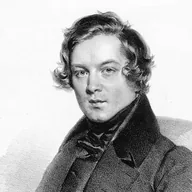 SchumannFrauenliebe und -leben, Op. 42SchumannLiederkreis, Op. 39SchumannAbegg Variations, Op. 1SchumannToccata in C major, Op. 7SchumannCarnaval, Op. 9SchumannPiano Sonata No. 1 in F-sharp minor, Op. 11SchumannPiano Sonata No. 2 in G minor, Op. 22SchumannFantasie in C major, Op. 17SchumannDavidsbündlertänze, Op. 6SchumannKinderszenen, Op. 15
 BachPassacaglia and Fugue in C minor, BWV 582Free
 HaydnString Quartet in D major, Op. 20 No. 4HaydnString Quartet in E-flat major, Op. 33 No. 2HaydnString Quartet in G major, Op. 33 No. 5HaydnSymphony No. 81 in G major, Hob. I:81HaydnSymphony No. 82 in C major, Hob. I:82HaydnSymphony No. 88 in G major, Hob. I:88HaydnPiano Sonata in C major, Hob. XVI:48HaydnPiano Sonata in E-flat major, Hob. XVI:49HaydnSymphony No. 94 in G major, Hob. I:94
Path 13
A poem, a voice and a piano, later an orchestra: from Schubert's first masterpieces to Strauss's last songs.
Schubert → Schumann → Wagner → Mahler → Debussy → Fauré → Strauss
Reviews