Piano Sonata No. 21 in C major, Op. 53
This guide follows Beethoven’s Piano Sonata No. 21 in C major, Op. 53 “Waldstein” (1804) in three parts: Allegro con brio (sonata form), Introduzione: Adagio molto (ternary form) and Rondo: Allegretto moderato (rondo).
- I
- II: molto
- III:
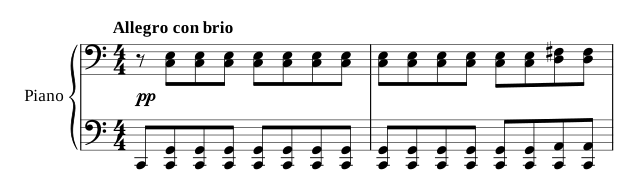
Quiet repeated chords in a nervous rhythm open the , with no melody for the first two . The rises and is then repeated a whole tone lower. The , a calm chordal marked e molto (sweetly and very smoothly), comes in E major, a third above the home rather than the expected G major. The starts in F major and moves through many keys. At the the in A major. The long recalls both themes.
- :
- : (a)
Section boundaries in music are not always sharp; a transition may be felt over a pause or a held chord.
At a glance
- I. Allegro con brio
- II. Introduzione: Adagio molto
- III. Rondo: Allegretto moderato
Questions
- How long is Piano Sonata No. 21 in C major, Op. 53?
- About 27 min in this recording, in 3 movements: I 11 min, II 4 min and III 11 min.
- What form are its movements in?
- I: sonata form, II: ternary form and III: rondo.
- How fast is it played?
- In this recording, measured from the score: I quarter note ≈ 151 bpm and III quarter note ≈ 94 bpm.
- Is there a score of Ludwig van Beethoven's Piano Sonata No. 21 in C major, Op. 53?
- Yes, of every movement.
More by Beethoven
See all → BeethovenPiano Sonata No. 1 in F minor, Op. 2 No. 1BeethovenPiano Sonata No. 2 in A major, Op. 2 No. 2BeethovenPiano Sonata No. 3 in C major, Op. 2 No. 3BeethovenPiano Sonata No. 20 in G major, Op. 49 No. 2BeethovenPiano Sonata No. 4 in E-flat major, Op. 7BeethovenPiano Sonata No. 19 in G minor, Op. 49 No. 1BeethovenPiano Sonata No. 5 in C minor, Op. 10 No. 1BeethovenPiano Sonata No. 6 in F major, Op. 10 No. 2BeethovenPiano Sonata No. 7 in D major, Op. 10 No. 3BeethovenPiano Sonata No. 8 in C minor, Op. 13Free
More in sonata form
See all → BachTrio Sonata No. 1 in E-flat major, BWV 525
 HaydnSymphony No. 1 in D major, Hob. I:1HaydnHorn Concerto in D major, Hob. VIId:3HaydnPiano Sonata in A-flat major, Hob. XVI:46HaydnPiano Sonata in C minor, Hob. XVI:20HaydnString Quartet in A major, Op. 20 No. 6HaydnString Quartet in C major, Op. 20 No. 2HaydnString Quartet in D major, Op. 20 No. 4HaydnString Quartet in E-flat major, Op. 20 No. 1HaydnString Quartet in F minor, Op. 20 No. 5
Reviews