Symphony Atlas

Symphony No. 9 in D minor, Op. 125

“Choral”18241 h 5 min

This guide follows Beethoven’s Symphony No. 9 in D minor, Op. 125 “Choral” (1824) in four parts: Allegro ma non troppo, un poco maestoso (sonata form), Molto vivace (sonata form), Adagio molto e cantabile (theme and variations) and Finale: Presto (theme and variations).

Recording: Berliner Philharmoniker, Herbert von Karajan

I Allegro ma non troppo, un poco maestoso · Sonata form · 23 sections

:
:
:
:
: :
:
:
:
:
:
:
:
:
:
: :
:
:
: ii
  1. I , un poco · Sonata form
  2. IIMolto · Sonata form
  3. III molto e · Theme and variations
  4. IV: · Theme and variations
I , un poco Sonata form0:15–15:10

, un poco , in D minor. It opens with bare open fifths (A and E) in quiet strings, which some listeners hear as an orchestra tuning, and the gathers out of them. There is no repeat. Then the starts. At the the fortissimo in D major instead of D minor. The is large, taking nearly a quarter of the .

  1. :
  2. :
  3. :
  4. :
  5. : :
  6. :
  7. :
  8. :
  9. :
  10. :
  11. :
  12. :
  13. :
  14. :
  15. : :
  16. :
  17. :
  18. : ii
IIMolto Sonata form15:20–25:42

Molto in D minor, a that opens with a fugue. Beethoven marks passages ritmo di tre battute and ritmo di quattro battute, rhythm of three and rhythm of four , so the triple-time music is heard in groups of three or four . The timpani have moments in the . The is in D major and in duple time, and it brings the first of the trombones. The after it, .

  1. : :
  2. : :
  3. : :
  4. : :
  5. : :
  6. : :
  7. : :
  8. : :
  9. : :
  10. : :
  11. : 3rd
  12. : 4th
  13. : 5th
  14. : 3rd
  15. : 4th
  16. : 5th
  17. : :
  18. : :
  19. : :
  20. : :
  21. : :
  22. : :
  23. : :
  24. : :
  25. : :
  26. : :
  27. : :
  28. : :
III molto e Theme and variations25:54–41:27

molto e in B-flat major, in variations on two themes. The slow, serene main melody alternates with a gentler idea in triple time in D major, and each in decorated form. The follows the , then come the first , the second and the . Fanfares interrupt the last , and a horn has a prominent .

  1. : A
  2. :
  3. : B
  4. B
  5. :
  6. I: A′: A1
  7. I:
  8. B1
  9. I:
  10. C
  11. II: A″: A2
  12. II: C: D
  13. II: C
  14. :
IV: Theme and variations41:32–1:05:03

in D major. Low-string recitatives the first three movements in turn. Then the cellos and basses introduce the Ode to Joy , and three instrumental variations follow. The baritone enters at the start of the second part with words by Beethoven himself, and the chorus takes up Schiller's poem. Later come a in Turkish style ( 7), a , a and a fast .

  1. :
  2. : of I
  3. : of II
  4. : of III
  5. : Ode to Joy
  6. Part 1: Ode to Joy
  7. Part 1: 1
  8. Part 1: 2
  9. Part 1: 3
  10. Part 1:
  11. Part 2:
  12. Part 2: 4
  13. Part 2:
  14. Part 2: 5
  15. Part 2:
  16. Part 2: 6
  17. Part 2:
  18. Part 3:
  19. Part 3: 7
  20. Part 3:
  21. Part 3: 8
  22. Part 3:
  23. Part 3: 9
  24. Part 3:
  25. :
  26. :
  27. : 10
  28. :
  29. : Part 1
  30. : Part 2

Section boundaries in music are not always sharp; a transition may be felt over a pause or a held chord.

At a glance

  1. I. Allegro ma non troppo, un poco maestosoSonata form · 15 min · 547 bars · quarter note ≈ 74 bpm
  2. II. Molto vivaceSonata form · 10 min · 954 bars · dotted half note ≈ 115 bpm
  3. III. Adagio molto e cantabileTheme and variations · 16 min · 157 bars · quarter note ≈ 46 bpm
  4. IV. Finale: PrestoTheme and variations · 24 min · 940 bars

Instruments: Piccolo, Flute, Oboe, Clarinet, Bassoon, Contrabassoon, Horn, Trumpet, Trombone, Timpani, Percussion, Soprano, Alto, Tenor, Baritone, Chorus, Violin I, Violin II, Viola, Cello, Double bass

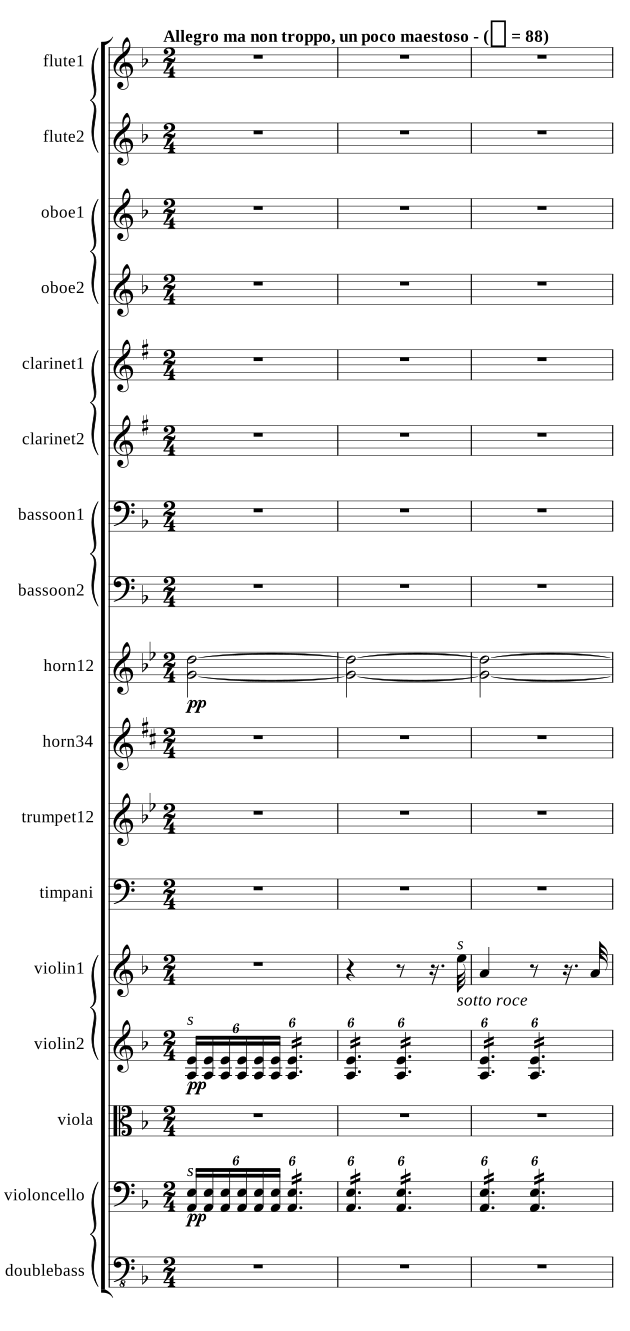
Ludwig van Beethoven, Symphony No. 9 in D minor, Op. 125, I. Allegro ma non troppo, un poco maestoso: first page of the score
Full score

Questions

How long is Symphony No. 9 in D minor, Op. 125?
About 1 h 5 min in this recording, in 4 movements: I 15 min, II 10 min, III 16 min and IV 24 min.
What form are its movements in?
I: sonata form, II: sonata form, III: theme and variations and IV: theme and variations.
Which instruments play in Symphony No. 9 in D minor, Op. 125?
Piccolo, Flute, Oboe, Clarinet, Bassoon, Contrabassoon, Horn, Trumpet, Trombone, Timpani, Percussion, Soprano, Alto, Tenor, Baritone, Chorus, Violin I, Violin II, Viola, Cello and Double bass.
How fast is it played?
In this recording, measured from the score: I quarter note ≈ 74 bpm, II dotted half note ≈ 115 bpm and III quarter note ≈ 46 bpm.
Is there a score of Ludwig van Beethoven's Symphony No. 9 in D minor, Op. 125?
Yes, of every movement.

Report a timing error

More by Beethoven

See all →

More in sonata form

See all →

In listening paths

See all →

Path 02

Symphonies everyone should know

Twelve symphonies from Mozart's Fortieth to Shostakovich's Fifth, the core of the concert repertoire.

Mozart → Haydn → Beethoven → Schubert → Berlioz → Mendelssohn → Brahms → Mahler → Tchaikovsky → Dvořák → Shostakovich

12 works · 8 h 9 min

Path 10

Beethoven's nine symphonies

From the First of 1800 to the Choral of 1824, in the order Beethoven wrote them.

Beethoven

9 works · 5 h 26 min

In the catalog

Ludwig van BeethovenSymphoniesClassical periodD minorSonata formTheme and variations

Join Symphony Atlas

Continue with GoogleCreate account

Have one? Sign in