Symphony Atlas

Symphony No. 9 in E minor, Op. 95

“From the New World”189346 min

This guide follows Dvořák’s Symphony No. 9 in E minor, Op. 95 “From the New World” (1893) in four parts: Adagio - Allegro molto (sonata form), Largo (ternary form), Scherzo: Molto vivace (minuet and trio) and Allegro con fuoco (sonata form).

Recording: hr-Sinfonieorchester, Andrés Orozco-Estrada

I Adagio - Allegro molto · Sonata form · 10 sections

: A
: B
:
:
:
:
:
:
  1. I - molto · Sonata form
  2. II · Ternary form
  3. III: Molto · Minuet and trio
  4. IV con · Sonata form
I - moltoSonata form0:24–12:36

A slow anticipates the . The fast music begins with the first , a -like call answered by a quick response; the call in later movements. The is in a minor with a lowered seventh, and a gentle in G major resembles the spiritual Swing Low, Sweet Chariot. The works mainly with the main and themes. The brings the later themes back a semitone higher, and the brass sound the in the .

  1. : A
  2. : B
  3. :
  4. :
  5. :
  6. :
  7. :
  8. :
IITernary form13:02–26:01

Hushed chords in the winds open the (the ), often heard as a musical 'once upon a time'. Then the cor anglais sings the main melody (A) in D flat major over muted strings. The (B) moves to C sharp minor and sounds lonely and homesick, then builds to a funeral--like passage over plucked basses. The main melody , and the ends with the opening chords.

  1. A
  2. B
  3. A
III: Molto Minuet and trio26:25–34:05

Dvořák linked this to the dance at the feast in Hiawatha. The stirring rhythm of the first section (A), with its falling fourths and timpani strokes, recalls the of Beethoven's Ninth. A gentler sits inside the first section, and a second dance with new themes (section B) follows, closer to a Czech folk dance than to anything American. The first section , and a solemn recalls the first 's .

  1. A
  2. A: B
  3. A: A′
  4. A:
  5. B: C
  6. B: D
  7. B: C′
  8. B: D
  9. B: C′
  10. B:
  11. A
  12. A: B
  13. A: A′
IV con Sonata form34:07–46:15

Horns and trumpets announce the (the first ) against sharp chords from the rest of the orchestra. The is a broad melody for clarinet over string tremolos. In the themes from the earlier movements come back and mix with the new ones. The starts in G minor before correcting to the home . The reviews material from the earlier movements, including the 's opening chords, and the symphony ends in E major.

  1. :
  2. :
  3. :
  4. :
  5. :
  6. :
  7. :
  8. :

Section boundaries in music are not always sharp; a transition may be felt over a pause or a held chord.

At a glance

  1. I. Adagio - Allegro moltoSonata form · 12 min · 605 bars · quarter note ≈ 119 bpm
  2. II. LargoTernary form · 13 min · 127 bars · quarter note ≈ 41 bpm
  3. III. Scherzo: Molto vivaceMinuet and trio · 8 min · 562 bars · dotted half note ≈ 80 bpm
  4. IV. Allegro con fuocoSonata form · 12 min · 348 bars · quarter note ≈ 137 bpm

Instruments: Flute, Oboe, Clarinet, Bassoon, Horn, Trumpet, Trombone, Tuba, Timpani, Percussion, Violin I, Violin II, Viola, Cello, Double bass

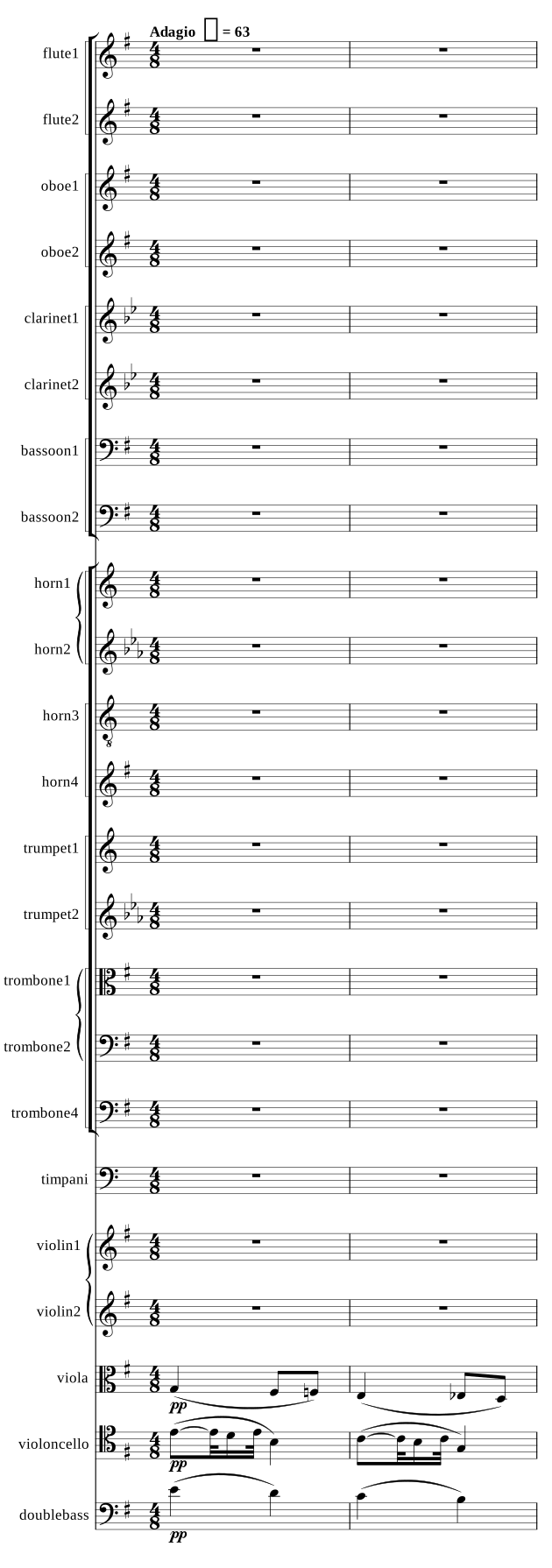
Antonín Dvořák, Symphony No. 9 in E minor, Op. 95, I. Adagio - Allegro molto: first page of the score
Full score

Questions

How long is Symphony No. 9 in E minor, Op. 95?
About 46 min in this recording, in 4 movements: I 12 min, II 13 min, III 8 min and IV 12 min.
What form are its movements in?
I: sonata form, II: ternary form, III: minuet and trio and IV: sonata form.
Which instruments play in Symphony No. 9 in E minor, Op. 95?
Flute, Oboe, Clarinet, Bassoon, Horn, Trumpet, Trombone, Tuba, Timpani, Percussion, Violin I, Violin II, Viola, Cello and Double bass.
How fast is it played?
In this recording, measured from the score: I quarter note ≈ 119 bpm, II quarter note ≈ 41 bpm, III dotted half note ≈ 80 bpm and IV quarter note ≈ 137 bpm.
Is there a score of Antonín Dvořák's Symphony No. 9 in E minor, Op. 95?
Yes, of every movement.

Report a timing error

More by Dvořák

See all →

More in sonata form

See all →

In listening paths

See all →

Path 02

Symphonies everyone should know

Twelve symphonies from Mozart's Fortieth to Shostakovich's Fifth, the core of the concert repertoire.

Mozart → Haydn → Beethoven → Schubert → Berlioz → Mendelssohn → Brahms → Mahler → Tchaikovsky → Dvořák → Shostakovich

12 works · 8 h 9 min

Path 24

Music of the nations

Folk songs, dances and landscapes, from Liszt's Hungary to Márquez's Mexico.

Liszt → Smetana → Grieg → Albéniz → Dvořák → Sibelius → Elgar → Vaughan Williams → Janáček → Villa-Lobos → Rodrigo → Márquez

12 works · 2 h 49 min

In the catalog

Antonín DvořákSymphoniesRomantic periodE minorSonata formTernary formMinuet and trio

Join Symphony Atlas

Continue with GoogleCreate account

Have one? Sign in