1862–1918 · Modern
Claude Debussy
35 works
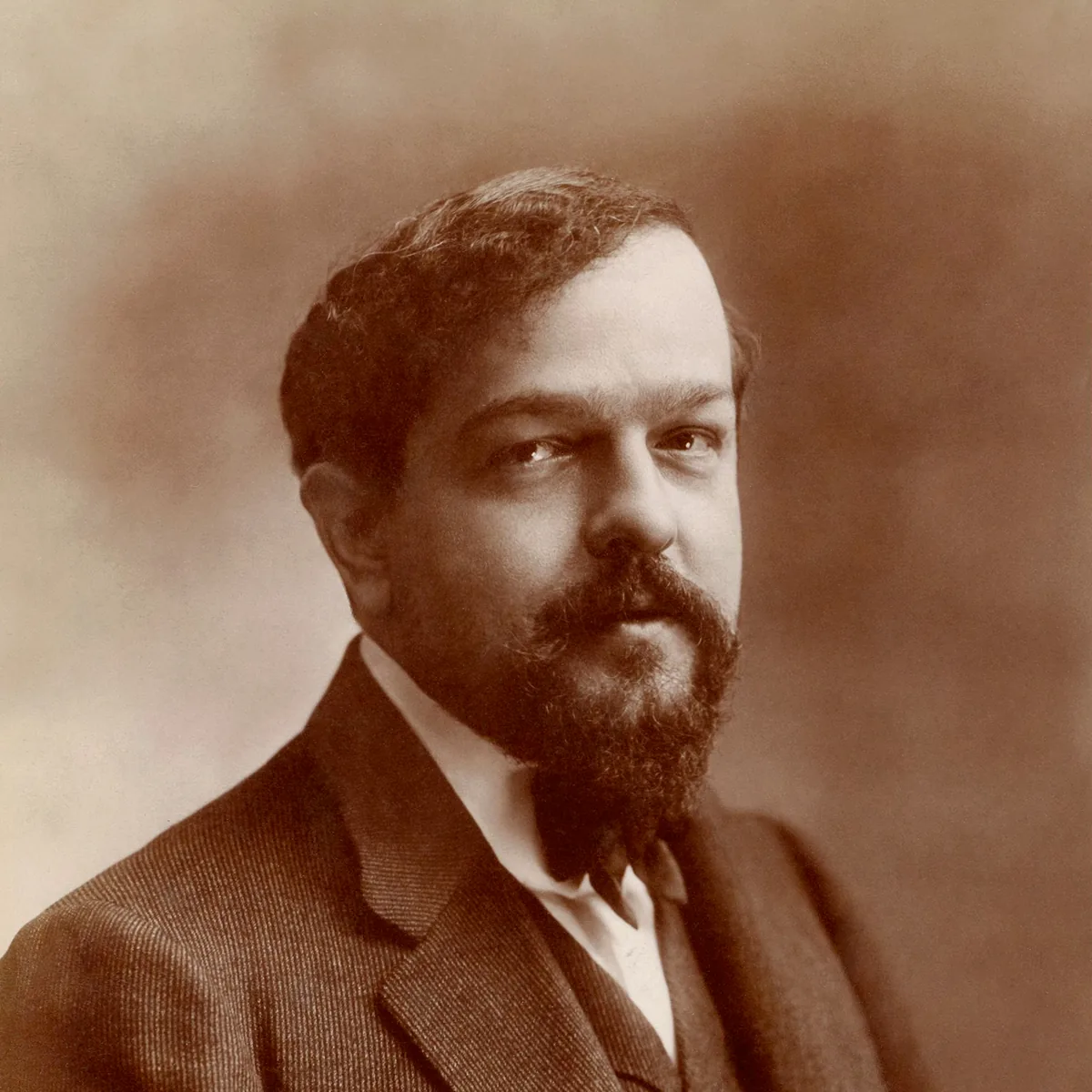
Debussy was born in Saint-Germain-en-Laye and entered the Paris Conservatoire at ten. He won the Prix de Rome in 1884. His music was largely a reaction against Wagner and the German tradition, and he objected to the label "Impressionist", though critics still use it. Symbolist poets such as Verlaine and Mallarmé shaped his approach, and he set many of their poems.
He used whole-tone, pentatonic and later octatonic scales, parallel chords, pedal points and modulations without preparation. The Javanese gamelan, which he heard at the 1889 Paris Exposition, influenced works such as "Pagodes" in Estampes. His orchestration prefers colour and texture to argument. The Prélude à l'après-midi d'un faune (1894), after Mallarmé's poem, opens with a solo flute that falls chromatically to a tritone below its starting note. La mer (1903 to 1905) is subtitled "three symphonic sketches", and its motifs grow by derivation from earlier ones.
The piano music includes Suite bergamasque, Pour le piano, Estampes (1903), L'isle joyeuse, two sets of Images, Children's Corner, and two books of Préludes (1909 to 1910 and 1911 to 1913), in which the titles stand at the end of each piece so they do not steer the player. Orchestral and solo works include the Nocturnes (1897 to 1899), the Dances for harp and string orchestra (1904) and the Première rhapsodie (1909 to 1910). The songs include Ariettes oubliées (Verlaine) and Fêtes galantes. The late chamber works are the Cello Sonata and the Sonata for flute, viola and harp (both 1915) and the Violin Sonata (1917), three of six planned sonatas.
What to listen for
- Whole-tone passages that float without a clear home note.
- Parallel chords: a chord that moves up or down as a block, used as colour rather than as a progression.
- Gamelan-like bell sounds and layered rhythms in Estampes.
- The solo flute at the start of the Faune, and the way the same melodic cell passes from instrument to instrument.
- In the Préludes, hear the picture in the music first and read the title afterwards, as Debussy intended.
Sources: Claude Debussy (Wikipedia), La mer (Debussy) (Wikipedia), Prélude à l'après-midi d'un faune (Wikipedia), Préludes (Debussy) (Wikipedia)
Works
 DebussyAriettes oubliées, L. 60DebussyRêverie, L. 68DebussyArabesque No. 1 in E major, CD 74/1; L. 66/1DebussyDeuxième Arabesque in G major, L. 66 No. 2DebussyFêtes galantes, première série, L. 80DebussyString Quartet in G minor, Op. 10, L. 85DebussyPrélude à l’après-midi d’un faune, L. 86DebussyTrois Nocturnes, L. 91DebussyPour le piano, L. 95DebussyEstampes, L. 100DebussyDanse sacrée et danse profane, L. 103DebussyL’Isle joyeuse, L. 106DebussyImages, Book I, L. 110DebussyLa mer, L. 109DebussySuite bergamasque, L. 75DebussyImages, Book II, L. 111DebussyChildren's Corner, L. 113DebussyPrélude I/1: Danseuses de Delphes, L. 117 No. 1DebussyPrélude I/2: Voiles, L. 117 No. 2DebussyPrélude I/3: Le vent dans la plaine, L. 117 No. 3DebussyPrélude I/5: Les collines d'Anacapri, L. 117 No. 5DebussyPrélude I/6: Des pas sur la neige, L. 117 No. 6DebussyPrélude I/4: Les sons et les parfums tournent dans l'air du soir, L. 117 No. 4DebussyPrélude I/7: Ce qu'a vu le vent d'Ouest, L. 117 No. 7DebussyPrélude I/8: La fille aux cheveux de lin, L. 117 No. 8DebussyPrélude I/9: La sérénade interrompue, L. 117 No. 9DebussyPrélude I/10: La Cathédrale engloutie, L. 117 No. 10DebussyPrélude I/11: La danse de Puck, L. 117 No. 11DebussyPrélude I/12: Minstrels, L. 117 No. 12DebussyPremière Rhapsodie for Clarinet and Orchestra, L. 116DebussyPréludes, Book II, L. 123DebussySyrinx, L. 129DebussyCello Sonata in D minor, L. 135DebussySonata for Flute, Viola and Harp, L. 137DebussyViolin Sonata in G minor, L. 140