Forms · Unit 5: Counterpoint
Canon and fugato
A is the strictest kind of imitation: one voice plays a melody and another follows with exactly the same melody, a fixed distance behind. A round, such as Frère Jacques, is a canon that can go on for ever, each singer returning to the start.
In Pachelbel’s Canon the three violins play a canon at the same pitch, each entering two bars after the last, over a bass that repeats throughout. The same music is always overlapping itself.
Mahler used a canon in the funeral march of his First Symphony, where the round Frère Jacques passes from instrument to instrument in a minor key.
Composers also borrowed the opening of a fugue for a passage inside a movement that is not a fugue. Such a passage is a : the theme enters in one voice after another, the texture thickens, and then the movement goes on its way.
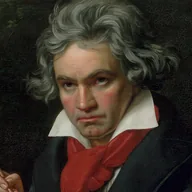 BeethovenSymphony No. 5 in C minor, Op. 67
In the trio of the third movement of his Fifth Symphony, Beethoven starts a fugato with the cellos and double basses rumbling a fast theme in C major. The other instruments take it up in turn.
Mozart did the same in the overture to The Magic Flute. After three solemn chords and a slow introduction, the Allegro sets off like a fugue, its quick theme entering in voice after voice. The three chords are widely heard as a sign of Freemasonry, to which both Mozart and his librettist belonged, and in the middle of the overture the wind play them again in three groups of three.