Forms · Unit 2: Forms that return
The scherzo
Scherzo is Italian for joke. Haydn used the name for the dance movements of his Op. 33 string quartets in 1781, and Beethoven made the his own: in most of his symphonies it takes the place of the minuet. His First Symphony still calls its third movement a minuet, but it already runs at the speed of a scherzo.
A scherzo keeps the minuet’s plan, scherzo, trio, scherzo, but it is much faster. Often the music moves so quickly that you feel one beat to the bar rather than three. Its humour can be playful, rough or uncanny, and its surprises come from sudden silences, loud accents and unexpected entries.
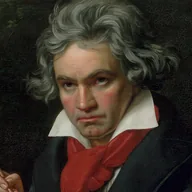 BeethovenSymphony No. 7 in A major, Op. 92
The scherzo of Beethoven’s Seventh Symphony races along in F major. Then the trio broadens into a slow, hymn-like tune in D major over a long held note, as if the music had stopped to look at the view. The tune is traditionally said to come from an Austrian pilgrims’ hymn, but no such hymn has ever been found.
Beethoven liked to stretch the plan. In the Seventh the trio comes twice, so the movement runs scherzo, trio, scherzo, trio, scherzo, and at the very end the trio begins a third time before a few loud chords cut it short.
BeethovenSymphony No. 5 in C minor, Op. 67In the Fifth Symphony the return of the scherzo is the surprise. Instead of coming back loudly, it returns as a ghost of itself: quiet, with the strings plucking, as if heard from far away.
Later composers kept the scherzo as a fast middle movement, and Schubert, Mendelssohn, Bruckner and Mahler wrote some of their most original music in it.