What is classical music? · Unit 4: Kinds of work
The string quartet
A is a work for two violins, a viola and a cello, and the four players who perform it are called a string quartet too. There is no keyboard to fill in the harmony, so the four parts are near equals.
Haydn did not write the first quartets, but in sixty-eight of them he gave the genre its lasting shape. In a letter of 1829 Goethe compared quartet playing to listening to four sensible people talking together, and the image fits: a phrase begun by one player is often finished by another.
A quartet usually follows the same plan as a symphony: a fast first movement, a slow movement, a minuet or scherzo and a lively finale. Beethoven’s last quartets, from the 1820s, break away from the usual plan, and in the twentieth century Bartók wrote six quartets and Shostakovich fifteen.
Schubert wrote his Quartet in D minor in March 1824. It is called Death and the Maiden because its slow movement is a set of variations on music from his own song of that name, from 1817, in which Death answers a frightened girl. The quartet keeps the usual four movements but stays dark from start to finish, and it was published only after Schubert’s death.
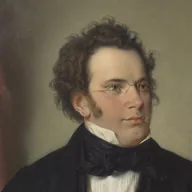 SchubertString Quartet No. 14 in D minor, D. 810
The opening shows how large four instruments can sound: all four strike a loud D together and hammer out a triplet figure; after a few bars the music drops to a hushed, tender phrase. The whole first movement swings between these two extremes, and the restless triplet rhythm comes back in all four movements.