What is classical music? · Unit 4: Kinds of work
Music for wind band
A has woodwind, brass and percussion but, unlike an orchestra, no strings, apart from an occasional double bass. With no violins to carry the tunes, the woodwind and brass take them over, and the percussion often has more to do.
Through the nineteenth century the large wind groups of Britain and America were mostly military bands. They played marches for parades and ceremonies, and arrangements of orchestral and opera music, because little original concert music had been written for them. Part of the problem was that no two bands had quite the same instruments.
Holst found a way round it. In his First Suite in E-flat, finished in 1909, he marked the parts a band could not do without and made the rest optional, so that small bands and large ones could both play it. Its first official performance came only in 1920, at the Royal Military School of Music at Kneller Hall, and its success encouraged other composers, Vaughan Williams among them, to write for band.
The suite has three movements, a chaconne, an intermezzo and a march, played without a break, and all three grow from the same three-note . A is a set of variations over a repeating theme: here an eight-bar tune, first heard in the low brass, comes round sixteen times while the music around it changes.
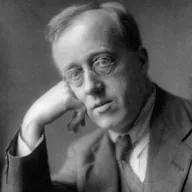 HolstFirst Suite in E-flat for Military Band, Op. 28 No. 1 / H. 105
In the middle of the Chaconne, the tune is turned upside down and moves into a minor key. The music grows hushed and sombre, with the theme now in the clarinets, a saxophone and the horns.
HolstFirst Suite in E-flat for Military Band, Op. 28 No. 1 / H. 105By the last variations the music has grown to full strength, and the Chaconne ends on a bright major chord. Holst asked for no pause here: the Intermezzo follows straight away.